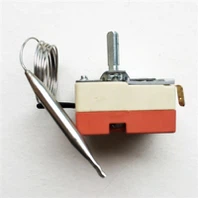
Thermostats are the unsung heroes of modern climate control, acting as the central nervous system for heating and cooling equipment. While their function-maintaining a set temperature-seems simple, the underlying mechanisms involve sophisticated physics and engineering. This guide explores the intricate process of how a thermostat converts environmental data into actionable commands, ensuring consistent thermal comfort and system efficiency.
The Core Principle: A Closed-Loop Control System
At its heart, a thermostat operates as a closed-loop control system. This means it continuously monitors the output (the current temperature) and compares it to the desired input (the setpoint). Based on this comparison, it makes adjustments to bring the two values into alignment. The entire process can be broken down into three fundamental stages:
Sensing: The thermostat detects the ambient temperature using a specialized sensor.
Comparing: The detected temperature is compared against the user-defined setpoint.
Actuating: If a discrepancy is detected, the thermostat sends a signal to the heating or cooling equipment to turn on or off.
This cycle repeats indefinitely, creating a dynamic equilibrium that prevents the environment from becoming too hot or too cold .
The Sensing Mechanism: From Physical Change to Electrical Signal
The first step in the control loop is accurate temperature measurement. Thermostats employ various types of sensors, each with unique operating principles suited to different applications.
2.1. Bimetallic Strips (Mechanical Thermostats)
Traditional mechanical thermostats rely on the physical properties of matter. They contain a bimetallic strip-a thin strip composed of two different metals (e.g., brass and iron) bonded together. Since the two metals have different coefficients of thermal expansion, the strip bends as the temperature changes. This physical movement is used to open or close an electrical circuit directly, turning the system on or off .
2.2. Electronic Sensors (Digital and Smart Thermostats)
Modern digital thermostats use electronic sensors for greater precision. The most common types include:
Thermistors: These are resistors whose electrical resistance changes significantly with temperature. They are highly sensitive and ideal for detecting small temperature changes in residential environments .
Thermocouples: These sensors generate a small voltage (the Seebeck effect) when two dissimilar metals are joined and exposed to a temperature gradient. They are known for their durability and wide temperature range, making them common in industrial heating systems .
RTDs (Resistance Temperature Detectors): Typically made of platinum, RTDs offer excellent accuracy and stability over a moderate temperature range. Their resistance increases predictably with temperature .
Signal Processing: Converting Raw Data into Actionable Intelligence
Once the sensor detects a temperature change, the raw signal must be processed. In electronic thermostats, this involves an Analog-to-Digital Converter (ADC). The ADC translates the analog voltage or resistance from the sensor into a digital value that the thermostat's microprocessor can understand.
The microprocessor then performs a critical calculation: it subtracts the measured temperature from the setpoint temperature. The result of this calculation determines the next action:
If the result is positive (measured temp < setpoint), the heating system is activated.
If the result is negative (measured temp > setpoint), the cooling system is activated.
If the result is zero or within a predefined tolerance, the system remains idle .
The Control Action: On/Off vs. Modulating
The final step is executing the command. Thermostats primarily use two types of control strategies:
4.1. On/Off Control (Bang-Bang Control)
This is the most common method. The thermostat acts as a simple switch. When the temperature deviates from the setpoint, it sends a full-power "on" signal. When the temperature reaches the setpoint, it sends an "off" signal. This method is simple and cost-effective but can lead to temperature fluctuations .
4.2. Modulating or Proportional Control
Advanced thermostats can modulate the output of the HVAC system. Instead of simply turning the furnace on at 100%, a modulating thermostat might signal the furnace to run at 40% capacity to maintain a more steady temperature. This eliminates the noticeable temperature swings associated with on/off control and improves energy efficiency .
The Critical Role of Hysteresis and Deadband
A key feature that prevents system wear and tear is hysteresis, often referred to as the deadband. If a thermostat turned the heat on the instant the temperature dropped below 70°F and off the instant it reached 70°F, the system would cycle on and off rapidly-a phenomenon known as "short cycling."
To prevent this, thermostats are designed with a built-in differential. For example, a thermostat might be set to turn the heat on at 69°F and off at 71°F. This 2-degree gap (the deadband) ensures that the system runs for a reasonable period, effectively heats the space, and then rests, thereby protecting the equipment from excessive wear .
Applications Beyond Home Comfort
While commonly associated with home HVAC, thermostats are critical in numerous industrial and specialized applications:
Industrial Process Control: Regulating temperatures in ovens, chemical reactors, and manufacturing processes where precise thermal conditions are crucial for product quality .
Refrigeration: Maintaining temperatures in cold storage facilities, refrigerators, and freezers to preserve perishable goods .
Automotive: The engine thermostat regulates coolant flow to ensure the engine reaches and maintains its optimal operating temperature quickly .
Conclusion: The Brain of Thermal Management
The thermostat's operation is a elegant dance of physics and electronics. By continuously sensing, comparing, and correcting, it maintains a delicate balance in our environments. From the simple bend of a metal strip to the complex algorithms of a smart thermostat, this device remains fundamental to energy efficiency, equipment longevity, and personal comfort.

One-stop Thermostats in China
Jaye Heater Technology specializes in industrial heating elements, offering OEM/ODM services for global clients.