

Silicone Rubber Heater

Jaye Heater is offering silicone rubber heaters renowned for their unparalleled advantages. Engineered with precision and innovation, our heaters redefine reliability and performance in various industries. One of the key advantages of Jaye Heater's silicone rubber heaters lies in our exceptional flexibility. Tailored to adapt seamlessly to diverse surfaces and contours, these heaters provide a solution for applications with complex geometries, ensuring optimal thermal efficiency. With a commitment to customer-centric design, Jaye Heater's silicone rubber heaters boast rapid heating response times. Experience the unparalleled speed at which our heaters achieve and maintain desired temperatures, delivering efficiency that surpasses industry standards.
Flexibility and Versatility
Jaye Heater's silicone rubber heaters are highly versatile This flexibility makes them suitable for a wide range of applications, including industrial, medical, automotive, and aerospace.
Durability
Jaye Heater prioritizes durability. Crafted from high-quality materials, our silicone rubber heaters exhibit robustness and resilience, ensuring longevity even in challenging environments.
Heat Uniformity
Silicone heaters made by Jaye ensure precise and consistent heat distribution, vital for optimal performance and product quality in various applications.
Custom Service
Customization is at the heart of our offerings. Our silicone rubber heaters are fully customizable, allowing for precise adjustments in size, shape, and wattage to meet your specific requirements.
Choose Jaye Heater's silicone rubber heaters that seamlessly integrates cutting-edge technology, adaptability, and reliability. Elevate your heating solutions with our silicone rubber heaters — a testament to excellence and innovation. Make the smart choice for superior performance and lasting value.
Heating Elements of Silicone Rubber Heater
Wire-Wound Element:
Jaye Heater's silicone rubber heaters feature an advanced Wire-Wound Element, ensuring precise and uniform heat distribution. Crafted with high-quality resistance wire, this element provides efficient warmth across the entire surface, making it ideal for applications requiring consistent heating. Its exceptional flexibility allows the heater to conform seamlessly to complex shapes. Engineered for durability, the Wire-Wound Element withstands challenging conditions, offering a reliable and long-lasting heating solution. Trust Jaye Heater to deliver cutting-edge technology, adaptability, and performance, setting a new standard for excellence in heating solutions. Choose innovation with Jaye Heater's silicone rubber heaters.

Etched Foil Element:

Jaye Heater's silicone rubber heaters boast the innovative Etched Foil Element, setting new standards in precision heating. Characterized by its thin, flat design, this element ensures efficient and uniform heat transfer across the entire silicone rubber surface. Its flexibility allows the heater to adapt seamlessly to complex shapes and contours, making it an ideal choice for diverse applications. The meticulous construction of the etched foil enhances durability, providing resilience in challenging environments. Choose Jaye Heater for cutting-edge technology that delivers adaptability and reliability in heating solutions. Elevate your applications with the exceptional performance of our silicone rubber heaters featuring the advanced Etched Foil Element.
Specifications of Silicone Rubber Heaters
|
Main Material |
Silicone(V0,V1) and imported silicone V0 options |
|
Temperature Rating |
400°F(204°C)maximum operating |
|
Size/Shape Limitations |
Maximum width of 48 inches(1200mm), no maximum length |
|
Thickness |
normally 0.03 inch/ 0.75mm (Single-Ply),0.06 inch / 1.5mm(Dual-Ply),support custom |
|
Voltage |
Any AC or DC (3V-660V), or 3phase |
|
Power density |
Normal 0.03-0.8watts per square centimeter,maximum 3W per square centimeter |
|
Power lead wire |
Silicone rubber, SJ Power Cord, or Teflon insulated stranded wire options,usually 100cm length or as requested |
|
Attachment |
Hooks, lacing eyelets, Temperature control(Thermostat), |
|
Max Watt Density |
60 watts/in² |
Watt Density And Temperature Rising Speed

Popular Types Of Flexible Silicone Heaters
Silicone rubber heaters come in various types to suit different applications and requirements. Some common types of silicone rubber heaters include:
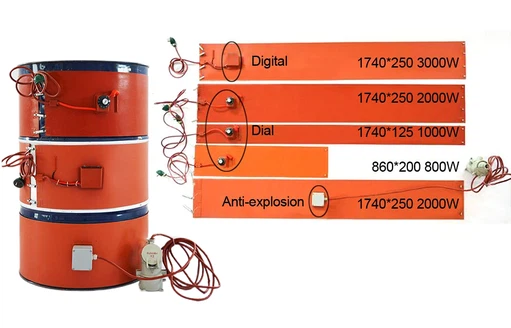
Silicone Drum Heaters
Silicone Drum heaters feature silicone rubber heating elements that adhere directly to the drum's surface, providing even heat distribution. They are customizable to fit different drum sizes and shapes.

Standard Silicone Rubber Heaters
Standard Silicone rubber heaters are versatile and can be customized to fit various shapes and sizes. They are commonly used for applications that require flexible heating solutions.

Spiral silicone heaters:
Spiral silicone heaters feature a specialized design for efficient and uniform heat distribution over curved or cylindrical surfaces, making them ideal for applications such as pipes and tanks.

Battery silicone heaters
Battery silicone heaters, crafted with flexible and efficient silicone elements, ensure optimal battery temperatures. Designed for easy customization to fit various battery shapes.

3D Printer Silicone Heater
The 3D printer silicone heater is a specialized heating element designed for optimal bed temperature control in 3D printing. Customizable for various bed sizes, it ensures quick and uniform heating across the bed.

Silicone Heat Press Heater
Jaye Heater's Silicone Heat Press Heaters offer precision and efficiency in heat transfer applications. Crafted with flexible silicone rubber, these heaters provide uniform heating, ensuring consistent and high-quality results.
-
![Insulated Pipe Heating Jacket]()
Insulated Pipe Heating Jacket
-
![Silicone Blanket For 30–32 Inch GRE Pipe]()
Silicone Blanket For 30–32 Inch GRE Pipe
-
![Silicone Heating Pad For Food Delivery Tables]()
Silicone Heating Pad For Food Delivery Tables
-
![IBC Heating Element]()
IBC Heating Element
-
![Silicone Heater For Garbage Disposal]()
Silicone Heater For Garbage Disposal
-
![Silicone Rubber Heater For Dough Fermentation Box]()
Silicone Rubber Heater For Dough Fermentation Box
-
![Silicone Rubber Heater For SPA And Sauna Equipment]()
Silicone Rubber Heater For SPA And Sauna Equipment
-
![Silicone Heater For Blood Warmer]()
Silicone Heater For Blood Warmer
-
![Silicone Drum Heater For Filling]()
Silicone Drum Heater For Filling
-
![Etched Foil Silicone Heating Pad]()
Etched Foil Silicone Heating Pad
-
![Custom Etched Foil Silicone Rubber Heating Pad]()
Custom Etched Foil Silicone Rubber Heating Pad
-
![Silicone Rubber Heater Sheet Heating Pad]()
Silicone Rubber Heater Sheet Heating Pad


Features Of Silicone Rubber Heating Elements
Flexibility and Versatility:
+
-
Silicone rubber heaters are known for their flexibility and versatility. They can be manufactured in various shapes and sizes to fit specific applications.
Excellent Thermal Stability:
+
-
Silicone rubber has good thermal stability, making it suitable for applications that require consistent and controlled heating.
Uniform Heat Distribution:
+
-
These heaters provide uniform heat distribution across the surface, ensuring that the entire area is heated evenly.
Chemical and Moisture Resistance:
+
-
Silicone rubber is resistant to many chemicals and moisture, making it suitable for applications in challenging environments.
Durable and Long-lasting Life:
+
-
Silicone rubber heaters are durable and can withstand exposure to various environmental factors, contributing to a longer lifespan.
The silicone rubber heater made by Jaye Heater Technology have higher heat transfer; Fast speed warm up, and decrease wattage requirements. Different mounting methods such as pressure sensitive adhesive, field applied adhesive, Velcro etc. are available according to the requirements
Silicone Heater Attachment Methods
Silicone rubber heaters offer versatile mounting options to accommodate various applications. Some common mounting methods for silicone rubber heaters include:

Pressure-Sensitive Adhesive (PSA)
Silicone rubber heaters often come with an adhesive backing that allows for easy attachment to the surface of the target object. PSA mounting is a simple and quick method that eliminates the need for additional hardware.

Hooks and Springs
For scenarios requiring the detachment of flexible heaters from cylindrical components, mechanical fasteners are provided as a solution.

Factory Vulcanization
Flexible heaters can undergo factory vulcanization to bond permanently with bare or anodized aluminum, stainless steel, marble, or other hard surfaces, ensuring excellent heat transfer.
This method creates a highly durable bond, as the silicone rubber seamlessly fills the microstructure on the metal's surface.

Velcro Strips:
For applications where ease of installation and removal is essential, Velcro strips can be used to attach the silicone rubber heater to the target object.

Three-Dimensional Configurations
Dimensional silicone rubber heaters can undergo vulcanization to conform to specific shaped outlines. This method proves particularly advantageous for enveloping silicone rubber heaters around pipes or small vessels. The process may necessitate the use of custom tooling or specialized forms.

Customized Mounting Solutions:
Depending on the specific requirements of an application, customized mounting solutions may be designed. This can include brackets, clips, or other fixtures tailored to the shape and size of the silicone rubber heater.
Silicone Heater Temperature Controls
Temperature controls for silicone rubber heaters are essential to regulate and maintain the desired temperature in a given application. Various types of temperature control devices and systems can be used in conjunction with silicone rubber heaters. Some common temperature control methods include:
Thermostats:
Thermostats are devices that sense the temperature and control the heating element to maintain a set temperature range. They can be mechanical or electronic and are available in various configurations, including adjustable setpoints and differential values.

Snap Action Thermostat - Automatic Reset:
This thermostat features a quick cutout on the rise to temperature. The contacts open when the temperature increases to the snap point of the calibrated bimetal disc. The setpoint (opens) is available in 10°F increments from 50 to 450°F. Electrical ratings include 125 Vac, 15 Amp, 1875W, and 250 Vac, 10 Amp, 2500W. The minimum heater width required is 1.312".

Adjustable Thermostat:
The adjustable thermostat allows users to dial in a specific temperature for the desired result. Enclosed in a molded silicone rubber housing and permanently attached to the heater, the thermostat has an adjustment shaft extending through a pre-formed hole. It includes a high-temperature knob. Amps are rated at 12.5A @ 125V and 6.5A @ 250V, with watts at 1500W @ 120V and 1560W @ 240V.

Creep Action Thermostat:
This thermostat provides sustained response and a slow cutout at the trip point. The creep action thermostat exhibits a slow make/slow break action around the setpoint. The setpoint (opens) is available in a limited selection from 50 to 300°F in 10°F increments (consult Tempco). Electrical ratings include 120 Vac, 12 Amp, 1440W, and 240 Vac, 6 Amp, 1440W.

Temperature Controllers:
Electronic temperature controllers provide precise control over the temperature. These controllers often include features such as digital displays, programmable setpoints, and PID (Proportional, Integral, Derivative) control algorithms for improved temperature stability.
Temperature Sensors:
Various temperature sensors, such as thermocouples or RTDs (Resistance Temperature Detectors), can be used to measure the temperature of the target surface or the environment. The feedback from these sensors is then used to control the power supplied to the silicone rubber heater.

Thermocouple
Jaye Heater can integrate common Type J or K thermocouples at nearly any location on the heater surface. Other thermocouple types are also applicable. Standard thermocouple temperature ranges are in effect. Specify preferences when placing an order. See Temperature Sensors for optional plugs.

RTD's
The platinum thin film RTDs (2- or 3-wire) used are 100 ohm @ 100°C, featuring a standard curve of 0.00385 TCR / DIN432760. Alternatively, other common RTDs, such as 1000 ohm, can be utilized; indicate your preference when ordering. The RTD's resistance increases with temperature rise, establishing it as the most accurate and stable sensor.

Thermistors
Jaye Heater also offers resistive-based temperature sensors like thermistors. These sensors typically exhibit non-linear responses and are suitable for use within a limited temperature range or at a specific single temperature. Small bead style thermistors can be directly affixed to the heater. The thermistor's response is typically integrated into the customer's electronic control system.
Thermal fuses:
Thermal fuses are safety devices used in conjunction with silicone rubber heaters to protect against overheating. These fuses are designed to open the electrical circuit and disconnect power if the temperature exceeds a predetermined threshold. This helps prevent damage to the heater and the surrounding components, enhancing safety in applications where temperature control is critical.

The choice of temperature control method depends on factors such as the application requirements, precision needed, and the complexity of the control system. It's important to follow the manufacturer's guidelines and recommendations for both the silicone rubber heater and the temperature control components to ensure compatibility and safe operation.
Flexible Silicone Heater Lead Location Options


Application Field Of Silicone Rubber Heaters

Medical Equipment:
Silicone rubber heaters are used in medical devices such as diagnostic equipment, patient warming systems, and laboratory apparatus where precise and controlled heating is required.

Food and Beverage Industry
These heaters are employed in food warming trays, vending machines, and food processing equipment to maintain specific temperatures for optimal product quality.

Aerospace and Aviation
Silicone rubber heaters are utilized in aerospace applications for de-icing of aircraft components, preventing ice buildup on critical surfaces.

Industrial Equipment
Various industrial processes require controlled heating, and silicone rubber heaters are used in equipment such as extruders, injection molding machines, and process heating applications.

Laboratory Instruments:
Instruments like analytical devices, incubators, and testing equipment often incorporate silicone rubber heaters for precise temperature control.
Semiconductor Manufacturing:
Silicone rubber heaters are used in semiconductor processing equipment for applications such as wafer processing and temperature control in cleanroom environments.

Oil and Gas Industry:
Silicone rubber heaters can be employed in heating elements for pipes, valves, and other components in the oil and gas industry to prevent freezing or viscosity issues.

Environmental Control Systems:
These heaters are used in environmental control systems, including climate chambers, to provide precise and uniform heating for testing and simulation purposes.

Automotive Industry:
Silicone rubber heaters find applications in automotive systems, including engine pre-heaters, battery warmers, and fluid reservoir heaters.

Consumer Electronics:
Silicone rubber heaters are utilized in various consumer electronics, including heated pads, portable heating devices, and warming elements for appliances.

Renewable Energy:
Silicone rubber heaters can be used in solar panels to prevent frost or ice formation and improve the efficiency of the panels.

Textile Industry:
In textile manufacturing, these heaters can be integrated into machines for processes like dyeing and drying.
The versatility, durability, and flexibility of silicone rubber heaters make them suitable for a wide range of applications where controlled and efficient heating is essential. The specific design and features of silicone rubber heaters can be tailored to meet the unique requirements of each application.
Jaye Heater Technology Co., Ltd. is one of the most professional silicone rubber heater manufacturers and suppliers in China, featured by high quality electric heating components. Please rest assured to wholesale custom made silicone rubber heater at competitive price from our factory. Silicone Flexible Band Heaters, Silicone Wrap Around Tank Heaters, Electrical Boxes Silicone Rubber Heaters