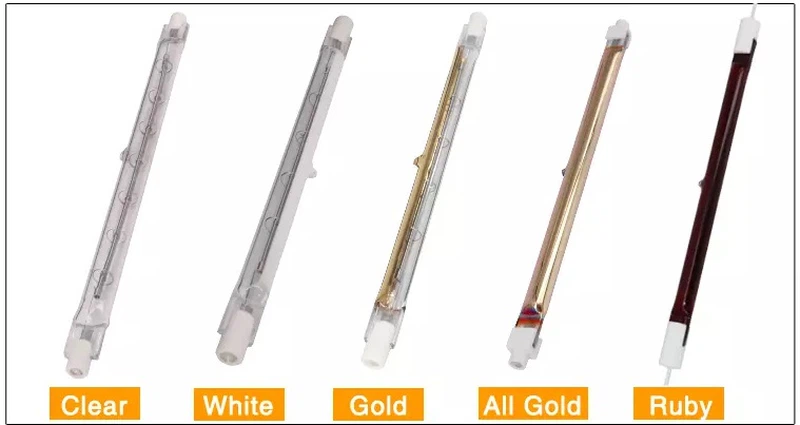
Quartz lamp tubes (specifically short-wave infrared quartz lamps filled with halogen gas) are a high-efficiency, precise, and controllable radiant heating element in the plastic thermoforming industry. The core of their working principle lies in converting electrical energy into high-intensity, easily adjustable short-wave infrared radiation, which penetrates the air and acts directly on the plastic sheet to achieve rapid and uniform heating.

Core Workflow and Principles
Energy Conversion: Electrical Energy → Infrared Radiation
When electric current passes through the tungsten filament inside the quartz lamp tube, the filament is heated to incandescence (typically above 2200°C), emitting intense electromagnetic radiation.
Quartz glass has extremely high infrared transmittance (over 95%) and a very low coefficient of thermal expansion. It efficiently transmits radiant energy while withstanding high temperatures without cracking.
The function of the halogen gas (halogen cycle) is to prevent evaporated tungsten from depositing on the tube wall, thereby maintaining the long-term brightness and thermal output stability of the lamp.
Energy Transfer: Non-Contact Radiant Heating
The radiation emitted by the quartz lamp tube contains a significant amount of short-wave and medium-wave infrared rays. This radiant energy travels in a straight line at the speed of light, hardly heating the air. The energy passes directly through the air and reaches the plastic sheet below.
Plastic materials (such as ABS, HIPS, PET, PMMA, etc.) have molecular structures with strong absorption characteristics for specific wavelengths of infrared radiation. Energy is efficiently absorbed when the frequency of the infrared rays matches the vibrational frequency of the plastic molecules.
Energy Absorption: Molecular Excitation and Heat Generation
The absorbed infrared energy causes the plastic molecules to vibrate more intensely, increasing intermolecular friction, which directly generates heat within the plastic. This is an inside-out heating method.
Since infrared rays can penetrate to a certain depth, they enable uniform heating throughout the thickness of the plastic sheet, not just the surface.
Thermoforming Preparation: Reaching the Ideal "Thermoelastic State"
As the plastic sheet temperature uniformly rises to a specific "thermoforming window" between its glass transition temperature (Tg) and melting temperature (Tm), the material changes from a rigid state to a soft, flexible "rubbery state" or "thermoelastic state".
In this state, the plastic sheet can be easily stretched and molded to the contours of the mold under low pressure, and retains its shape upon cooling.
Key Advantages in Plastic Thermoforming
| Advantage | Detailed Explanation |
|---|---|
| Extremely Fast Heating | Reaches full power output within 1-2 seconds of startup, requiring no preheating, significantly shortening production cycles. |
| High Efficiency & Energy Saving | Radiant energy goes directly to the target with minimal heat loss. Typically saves 30%-50% energy compared to traditional hot air convection heating. |
| Precise Control | Enables zone control (Zoning), allowing independent adjustment of lamp power in different areas. This achieves "differential heating" for complex shapes, ensuring uniform temperature across the sheet. For example, edges and deep-draw areas can receive higher power than flat areas. |
| Uniform Heating | Short-wave infrared has strong penetration, enabling uniform heating through the thickness of the sheet, preventing surface overheating while the inner layer remains cold and stiff, thereby reducing molding defects. |
| Rapid Response | Heats instantly when powered on and stops instantly (except for residual heat) when powered off. Temperature adjustment response time is measured in seconds, facilitating precise process control. |
| Reduced Oxidation | Non-contact heating minimizes surface oxidation and degradation of the plastic caused by hot air flow, which is especially beneficial for materials sensitive to oxidation like PET. |

Typical System Configuration and Application Forms
Heater Array: Multiple quartz lamp tubes are arranged above the forming machine in a heating panel matching the sheet size, divided into multiple independently controlled temperature zones.
Reflector: A polished aluminum reflector behind the lamp tubes redirects upward radiation back onto the sheet, increasing thermal efficiency to over 90%.
Control System: Integrates PID temperature controllers and infrared thermometers (e.g., pyrometers) to monitor the sheet surface temperature in real-time and provide feedback to adjust lamp power, forming a closed-loop control.
Application Types:
General Thermoforming: Used to produce trays, cup lids, refrigerator liners, bathtubs, automotive interior parts, etc.
Heavy-Gauge Sheet Forming: Particularly suitable for heating sheets thicker than 10mm due to its powerful penetration capability.
High-Performance Plastic Forming: Used for engineering plastics like PC and PMMA that require precise temperature control.
Summary
In plastic thermoforming, the quartz lamp tube is an efficient "directional energy transfer system." It bypasses the inefficient traditional process of "heating air → convective transfer" by converting electrical energy directly into short-wave infrared radiant energy that "resonates" with the plastic molecules. This achieves rapid, uniform, controllable, and energy-efficient heating of plastic sheets, making it one of the core technologies for high-quality, high-efficiency thermoforming production.