Medical and laboratory equipment often require controlled and repeatable heating rather than high temperatures.
Applications such as adhesive dispensing, reagent handling, sample preparation, fluid warming, and diagnostic instruments depend on stable thermal performance to support process consistency and equipment reliability.
In these applications, overheating can be just as problematic as insufficient heating. Excessive temperatures may affect material properties, while temperature fluctuations can lead to inconsistent results. For this reason, many equipment manufacturers choose PTC insulated film heaters as a compact and self-regulating heating solution.
Why Temperature Stability Matters
One of the most common challenges in medical and laboratory equipment is maintaining a consistent operating temperature throughout the process cycle.
Materials such as medical adhesives, sealants, reagents, and specialty fluids often exhibit significant viscosity changes within a relatively narrow temperature range.
If the temperature exceeds the intended operating window, material performance may be affected. If the temperature falls below the target range, flow characteristics and dispensing accuracy can become difficult to control.
Unlike conventional resistance heaters that continuously increase temperature until controlled externally, a PTC heating element naturally reduces power output as it approaches its designed operating temperature.
This characteristic helps limit temperature overshoot and contributes to more stable thermal behavior.
How PTC Insulated Film Heaters Work
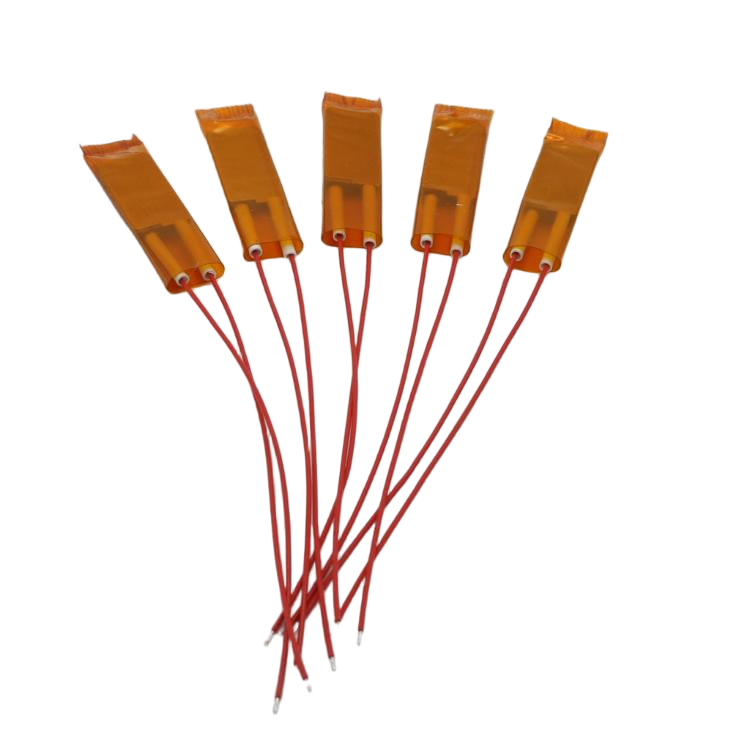
PTC stands for Positive Temperature Coefficient. As the heater temperature increases, the electrical resistance of the PTC element rises accordingly. The increase in resistance reduces current flow, which in turn limits further temperature rise.
This self-regulating effect provides several practical advantages for medical and laboratory equipment manufacturers:
- Reduced risk of overheating
- More stable operating temperatures
- Simplified thermal management
- Compact heater construction
- Improved system safety
To accommodate different installation environments, PTC elements can be combined with flexible PI (Polyimide) or PET insulation films, creating a thin and lightweight heater structure suitable for confined spaces.
Engineering Considerations for Medical Equipment Designers
Selecting a heater involves more than choosing a voltage and temperature rating. During product development, engineers typically evaluate several factors that directly influence heating performance.
Operating Temperature Requirements
The required temperature should be determined based on the characteristics of the material being heated rather than the maximum heater capability. In many medical and laboratory applications, maintaining a stable process temperature is more important than achieving high temperatures.
Installation Space
Compact medical devices often have limited space available for thermal components. Flexible film-based PTC heaters can be designed to fit around mechanical structures, reservoirs, dispensing modules, or fluid pathways.
Power Supply Constraints
Many portable and benchtop devices operate on low-voltage DC power supplies. Heater design should consider startup current, steady-state power consumption, and overall power availability within the system.
Thermal Interface Design
The effectiveness of a heater depends not only on its output but also on how efficiently heat is transferred to the target component. Surface contact quality, mounting method, insulation structure, and environmental conditions all influence overall performance.
Typical Design Parameters
| Parameter | Typical Options |
|---|---|
| Operating Voltage | 12VDC, 24VDC, 48VDC, 110VAC, 220VAC |
| Curie Temperature | 50°C, 70°C, 90°C, 120°C, 150°C, 180°C |
| Insulation Material | PI Film, PET Film |
| Heater Geometry | Flat, Circular, Irregular, Custom Shapes |
| Mounting Method | Adhesive Backing, Mechanical Clamping, Direct Contact |
| Lead Configuration | Customized |
| Protection Options | Thermal Fuse, Thermostat, Temperature Sensor Integration |
| Connection Options | Wire Leads, Connectors, Custom Assemblies |
Actual performance depends on thermal load, installation conditions, ambient temperature, and system design.
Typical Applications
PTC insulated film heaters are used in a wide range of medical, laboratory, and analytical equipment.
Medical Adhesive and Sealant Dispensing Systems
Controlled heating helps maintain stable viscosity and improve dispensing consistency for temperature-sensitive materials.
Diagnostic and Analytical Instruments
Many diagnostic systems require localized heating to support testing procedures, sample conditioning, or fluid handling processes.
Reagent and Sample Warming Modules
Stable low-temperature heating can help maintain suitable operating conditions for reagents and biological samples.
Fluid Management Systems
PTC heaters are commonly integrated into fluid pathways, reservoirs, and warming assemblies where controlled temperatures are required.
Portable Medical Devices
The compact size and self-regulating characteristics of PTC heaters make them suitable for portable equipment with limited installation space and power availability.
OEM Customization Support
Medical and laboratory equipment rarely use standard heater configurations. Most projects require custom dimensions, electrical specifications, mounting arrangements, and connection methods.
Jaye Heater works with OEM manufacturers during product development to evaluate:
- Required operating temperature
- Available installation space
- Voltage and power requirements
- Heater geometry
- Mounting conditions
- Wiring and connector configurations
- Insulation and protection requirements
By considering these factors during the design stage, heater integration can be simplified and potential redesign work reduced later in the project.
Material Selection Considerations
The insulation film, adhesive system, lead wires, and connection components should all be selected according to the intended operating environment.
PI film is generally preferred for applications requiring higher temperature resistance and long-term thermal stability. PET film may be suitable for lower-temperature applications where flexibility and cost efficiency are priorities.
For projects with specific regulatory or environmental requirements, material selection should be reviewed during the design phase to ensure compatibility with the intended application.
Frequently Asked Questions
What temperature range can a PTC insulated film heater provide?
The operating temperature depends on the selected Curie temperature, installation conditions, thermal load, and heat dissipation characteristics of the application.
Can PTC heaters operate continuously?
Yes. PTC heaters are widely used in continuous-duty applications because their self-regulating characteristics help maintain stable operating temperatures.
Are custom shapes available?
Yes. Heater dimensions, cutouts, mounting holes, lead locations, and overall geometry can be customized to match equipment requirements.
Which insulation material is better, PI or PET?
The choice depends on operating temperature, mechanical requirements, and installation conditions. PI film is generally selected for higher-temperature and more demanding environments, while PET film is commonly used in lower-temperature applications.
Can temperature sensors be integrated into the heater assembly?
Yes. Depending on the application, thermistors, thermostats, thermal fuses, or other temperature-monitoring components can be incorporated into the heater design.

One-stop PTC Factory in China
Send your inquiry about cosmetic tubes to us and experience the transformative power it can have on your business.