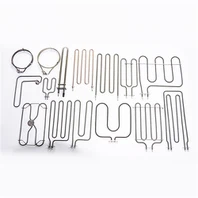
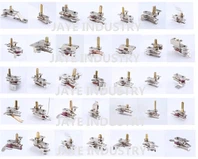
A KST thermostat is a temperature control switch commonly used in electric irons. Its primary function is to maintain the desired ironing temperature by automatically switching the heating element ON and OFF.

Working Principle
1. Power ON
When the electric iron is plugged into the power supply, electricity flows through the KST thermostat to the heating element. The heating element begins converting electrical energy into heat.
2. Temperature Sensing
Inside the KST thermostat is a bimetallic strip made from two different metals bonded together. Since the two metals have different coefficients of thermal expansion, the strip bends as its temperature increases.
3. Heating Process
As the soleplate temperature rises, the bimetal strip gradually bends toward the opening mechanism.
4. Temperature Cut-Off
When the preset temperature is reached, the bending force of the bimetal strip causes the electrical contacts inside the thermostat to open. This interrupts the electrical circuit, stopping power to the heating element. The indicator lamp usually turns OFF at this point.
5. Cooling Process
After power is disconnected, the soleplate gradually cools during use. As the temperature decreases, the bimetal strip returns to its original shape.
6. Automatic Reconnection
When the temperature falls below the preset level, the contacts close again, restoring power to the heating element. The indicator lamp turns ON, and the heating cycle repeats automatically.
Temperature Adjustment
The temperature control knob changes the mechanical position of the thermostat mechanism, which adjusts the contact opening point. This allows users to select different ironing temperatures for various fabrics, such as:
- Low: Nylon, Silk
- Medium: Wool, Polyester
- High: Cotton, Linen

Advantages of KST Thermostats
- Automatic temperature control
- Reliable over-temperature protection
- Simple mechanical design
- Long service life
- Low manufacturing cost
- No external electronic controller required

KST Thermostat Specification (Electric Iron)
| Item | Specification |
|---|---|
| Product | KST Thermostat |
| Application | Electric Iron |
| Function | Automatic temperature control |
| Operating Principle | Bimetal thermostat with automatic ON/OFF switching |
| Temperature Control | Adjustable by temperature control knob |
| Temperature Range | Customized |
| Contact Type | Normally Closed (NC) |
| Operating Voltage | Customized |
| Rated Current | Customized |
| Temperature Accuracy | Customized |
| Reset Type | Automatic reset |
| Sensor Type | Bimetal strip |
| Switching Action | Opens circuit at set temperature and recloses after cooling |
| Mounting | Screw mounting to iron soleplate |
| Typical Applications | Dry iron, steam iron, travel iron, household electric iron |

Typical Working Cycle
- Power ON
- Heating element heats the soleplate
- Soleplate reaches the set temperature
- KST thermostat opens the contacts
- Heating stops
- Soleplate cools during ironing
- Thermostat closes the contacts
- Heating resumes automatically
This ON/OFF cycling maintains the soleplate temperature within a controlled range, ensuring safe and effective ironing performance.
FAQ – KST Thermostat in an Electric Iron
FAQ 1: Why does the indicator light turn ON and OFF repeatedly during use?
Answer:
This is normal operation. The KST thermostat automatically switches the heating element ON and OFF to maintain the selected temperature. The indicator light turns ON when the iron is heating and turns OFF when the set temperature has been reached.
FAQ 2: Why is the iron not heating?
Answer:
Possible causes include:
- The power supply is disconnected.
- The temperature setting is too low.
- The KST thermostat contacts are damaged or worn.
- The heating element has failed.
- Internal wiring is loose or disconnected.
Inspect the power source and temperature setting first. If the problem persists, the thermostat or heating element should be checked or replaced.
FAQ 3: Why does the iron become too hot or fail to maintain the correct temperature?
Answer:
This may occur if the KST thermostat is malfunctioning or incorrectly calibrated. A damaged bimetal strip or worn contacts may prevent the thermostat from switching properly, causing overheating or unstable temperature control. Replace the thermostat with the correct specification if necessary.