Virtually any hopper shape can be fitted with custom silicone pads, as the pads are specifically designed and molded to match the exact contours of your hopper. The flexibility and custom manufacturing process of silicone make it adaptable to complex geometries. Here's a breakdown by common hopper shapes:
Conical Hoppers:
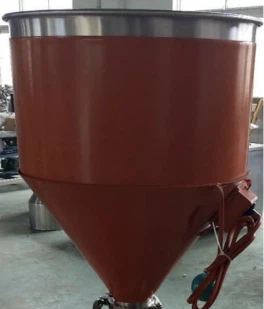
Best Suited: The smooth, continuous curve of a cone is the easiest shape to fit with a silicone liner/pad.
Implementation: A single, seamless conical sleeve or large panels shaped to the cone angle can be fabricated and installed. The pad naturally conforms to the curvature.
Rectangular/Square Hoppers (and Transition Hoppers):
Well Suited: Very common and readily accommodated.
Implementation: Typically fabricated as multiple flat or slightly curved panels:
Four side panels (one for each wall).
A separate bottom panel (if applicable, like a slide gate interface).
Corners are Key: The design must carefully address the corners. Options include:
Pre-molded corner sections that fit precisely.
Designing the flat panels to overlap slightly at corners, relying on silicone's flexibility to conform.
Creating a single complex mold for the entire rectangular section (less common due to cost/size).
Pyramidal Hoppers:
Well Suited: Similar to rectangular hoppers but with sloped sides meeting at a point or short outlet.
Implementation: Fabricated as four triangular (trapezoidal) panels, one for each sloped face. The challenge is the junction of the four slopes at the bottom (the "apex").
Apex Solution: A custom-molded "apex cap" or carefully designed overlapping/joining of the four panels at the bottom is crucial for a good seal and flow.
Planar Flow/Wedge Hoppers:
Suited: Designed for very difficult materials, often with two steep, converging walls and two nearly vertical end walls.
Implementation: Requires custom panels for the two steep sloped walls and the two (usually steeper) end walls. Precise molding for the critical flow channels and corners is essential.
Circular/Cylindrical Sections (above conical):
Well Suited: Similar to conical, the continuous curve is ideal.
Implementation: A cylindrical sleeve or segmented panels designed to match the curve.
Irregular or Complex Shapes:
Possible, but More Complex/Expensive: Hoppers with unique bends, non-standard angles, internal baffles, or complex transitions can still be fitted.
Implementation: Requires highly customized design and molding. May involve multiple complex pieces or even a single large, intricate mold. Cost and lead time increase significantly.