Introduction: The Scale of the Challenge
Heating a small tank of water is straightforward. Scaling this process to industrial volumes-thousands of liters in a storage tank, a process vessel, or a circulation line-introduces complexities that demand a robust and engineered solution. The primary goal shifts from simply raising temperature to doing so efficiently, uniformly, safely, and cost-effectively over a prolonged lifespan. Traditional methods like steam jackets or rudimentary heating elements often fall short, leading to escalated energy bills, maintenance nightmares, and process bottlenecks.
It is within this context that the JAYE-HEATER Flange Heater has been engineered. As a Top 10 heating element manufacturer in China, we have designed our flange heaters not merely as components, but as integrated heating systems that directly address the core pain points of large-scale liquid heating.

Part 1: Deconstructing the Primary Large-Scale Liquid Heating Challenges
To appreciate the solution, one must first understand the problems.
1.1. Prohibitive Energy Consumption and Low Thermal Efficiency
- The Problem: Inefficient heaters act as a direct drain on profitability. Systems with poor thermal coupling or excessive heat loss to the environment force generators to work longer and harder, leading to unsustainable energy costs. A significant amount of input energy can be wasted heating the surrounding air or equipment housing rather than the target liquid.
- The Impact: High operational expenditure (OPEX) and a larger carbon footprint, making the process environmentally and economically unviable.
1.2. Inconsistent Heating and Temperature Stratification
- The Problem: Without proper element placement and flow dynamics, large tanks develop severe temperature gradients. Hot liquid rises, leaving colder layers at the bottom-a phenomenon known as thermal stratification. This results in inconsistent product quality, improper chemical reactions, and inaccurate process control.
- The Impact: Reduced product yield, compromised process integrity, and the need for excessive mechanical agitation, which further increases energy use.
1.3. Critical Safety Hazards
- The Problem: The two most significant risks are dry-firing and corrosion-induced failure. Dry-firing occurs when the heating element is energized without being fully submerged, causing it to overheat and burn out catastrophically in minutes. Corrosion from aggressive chemical media can eat through a heater's sheath, leading to leaks, electrical shorts, and contamination.
- The Impact: Equipment destruction, unplanned downtime, potential for fire, and severe safety risks to personnel.
1.4. Mechanical Failure and High Maintenance Demands
- The Problem: Large volumes of liquid exert significant pressure and cause vibration. Low-quality heaters with weak joints or thin sheath materials are prone to mechanical failure. Furthermore, scale build-up (fouling) on the heater surface insulates the elements, reducing efficiency and causing overheating.
- The Impact: Frequent, costly replacements, prolonged production stoppages, and high maintenance labor costs.
1.5. Lack of Customization and Poor System Integration
- The Problem: Off-the-shelf heaters rarely fit unique application requirements perfectly. A "one-size-fits-all" approach leads to compromises in power density, physical dimensions, material compatibility, and control integration.
- The Impact: Suboptimal performance, reduced lifespan, and an inability to meet specific process temperature profiles or control protocols.


Part 2: The JAYE-HEATER Flange Heater: An Engineered Response
The JAYE-HEATER Flange Heater is meticulously designed to overcome each of these challenges systematically.
2.1. Unrivaled Design and Construction for Maximum Durability
- Robust Flange Assembly: We use high-tensile carbon steel or stainless steel flanges, machined to perfection to ensure a leak-proof seal against your tank or vessel. Standard configurations comply with ANSI, DIN, or JIS standards, and custom sizes are readily available.
- Superior Sheath Material: The heating elements are constructed from a range of premium materials, including:
Incoloy 800/840: For high-temperature applications and resistance to oxidation.
316/316L Stainless Steel: The standard for most water and mild chemical applications.
Titanium: Essential for heating chlorinated water and certain corrosive acids.
Hastelloy: For the most aggressive chemical environments.
- High-Density Magnesium Oxide (MgO) Fill: This highly compacted, mineral-based insulation ensures maximum heat transfer from the resistance wire to the sheath while maintaining superb dielectric strength for electrical safety.
2.2. Exceptional Thermal Efficiency and Uniform Heat Distribution
- Direct Immersion Technology: By installing directly into the liquid, our flange heaters achieve near-direct contact heat transfer, eliminating intermediate losses. Thermal efficiency regularly exceeds 95%.
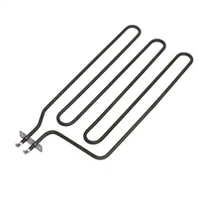
- Strategic Element Configuration: The U-shaped or W-shaped heating tubes are strategically bent and spaced to distribute heat evenly across a large volume. This design minimizes cold spots and prevents thermal stratification, ensuring a consistent temperature throughout the vessel without the need for excessive external mixing.
2.3. Integrated Multi-Layer Safety Systems
- Comprehensive Dry-Fire Protection: We integrate either a built-in thermal fuse (non-resettable) or a resettable adjustable thermostat directly into the heater well. This sensor trips at a pre-set temperature, cutting power instantly if the liquid level drops, safeguarding your investment.
- Advanced Corrosion Management: Our technical team works with you to select the optimal sheath material for your specific chemical medium, ensuring long-term resistance to corrosion and preventing premature failure and fluid contamination.
- Secure Grounding and Over-Temperature Protection: All our heaters feature a standard grounding terminal, and options for sophisticated SCADA-integrated temperature controls are available for the highest level of process safety.
2.4. Engineered for Longevity and Ease of Maintenance
- Pressure-Resistant Construction: The robust welding of the elements to the flange and the thick sheath walls are designed to withstand the internal pressures of large tanks and the stresses of industrial environments.
- Easy Installation and Servicing: The flange-mount design is a key advantage. A single unit with multiple heating elements can be installed or removed by simply unbolting the flange, dramatically simplifying initial setup and any future maintenance compared to screwing in dozens of individual cartridge heaters.
2.5. Deep Customization Capability
At JAYE-HEATER, we pride ourselves on providing tailored solutions, not just standard products. Our engineering team can customize:
- Power Density & Voltage: Tailored to your heating rate requirements and local electrical supply.
- Flange Size, Shape, and Drilling: To fit any existing tank nozzle.
- Sheath Material, Diameter, and Layout: Optimized for your medium, space, and heat distribution needs.
- Integrated Sensors and Control Compatibility: From simple thermocouples to complex PLC interfaces.

Conclusion: A Strategic Investment in Operational Excellence
Choosing a heating system for large-scale liquids is a critical capital decision. Opting for a low-cost, inferior product inevitably leads to higher lifetime costs through energy waste, frequent failures, and safety incidents.
The JAYE-HEATER Flange Heater represents a strategic investment. It is a precision-engineered product that delivers tangible returns through reduced energy consumption, minimized downtime, enhanced process safety, and an extended service life. By directly addressing the fundamental challenges of industrial liquid heating, it provides not just heat, but also reliability, control, and peace of mind.