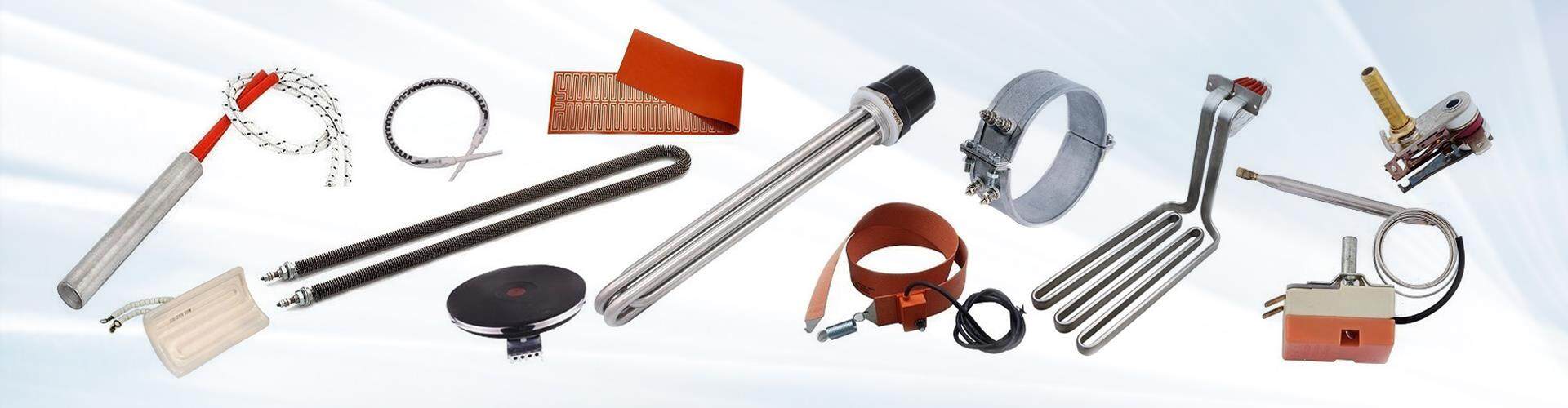
In order to reduce the working temperature of the electric connector of the heater, measures can be taken from the following aspects to reduce the working temperature of the electric connector of the electric heating element and improve the working reliability of the electric heating element connector.
(1) Enhance the contact pressure between crimping connecting conductors: within a certain pressure range, the greater the force, the smaller the contact resistance. However, if the pressure exceeds a certain limit, the contact resistance will no longer change significantly with the increase of pressure. One of the purposes of crimping wire bolts and nuts with metal spring pads of corresponding specifications is to ensure that moderate and constant contact pressure is always maintained between connecting conductors, so as to reduce the contact between conductors. Since the outgoing connecting wires of the heating body are mostly the heating body itself, the temperature fluctuation at the working place of the joint is large. The thermal expansion and cold contraction between the connection points of the wiring are not equal, resulting in a gap between the contacts, resulting in an increase in the contact resistance and an increase in the contact temperature when the current passes through. Installing spring pads between contacts can maintain the gap between connecting conductors during thermal expansion and cold contraction.
The contact pressure is constant and the gap between the contact surfaces is constant, so as to ensure the constant contact resistance between the contacts.

(2) Reduce the wiring resistance of electric heating element: usually, the electric heating element directly leads out the internal heating wire (resistance wire) as its connecting wire (this is most common in general electric heating furnaces. One part of the electrical connector is caused by the contact resistance of the connector itself, and the other part is caused by the lead resistance of the electric heating element. The resistance value of the lead and the lead terminal of the electric heating element are made on the production site. When using the electric heating element (such as the wire terminal of the electric furnace and the heating plate terminal of the electric soldering iron), According to the distance between the main heating area and the terminal (set as 1), leave 2L or more length of the heating wire, straighten it, and then twist its 2 or 3 strands in parallel to make it complete ly- body. Then bend or crimp the joint according to the actual situation. In this way, the resistance value of the heater lead will drop to the original value of 1 / 3 ~ 1 / 2 due to the increase of the contact area, The corresponding calorific value will also drop to 1 / 3 ~ 1 / 2 of the original value. If the diameter of the electric heating wire is small, the electric heater bow bent back and forth can increase some shares in the outer part of the wire.
(3) Enhance the heat dissipation and ventilation effect at the electrical joints of electric heating elements: for high-power equipment, due to the number of electric heating elements and corresponding electrical connection points, the connected contact resistance and lead resistance points will also produce more heat. If the heat is not dissipated in time, local overheating will occur near the electrical contact and around the bow, resulting in overheating of the heating element, high-temperature corrosion and damage to the bow and contact. Therefore, for the wiring of high-power electric heating equipment, the connection between the main power line and the branch line of each heating element generally does not adopt direct crimping or splicing, but should be equipped with blocks with certain thermal conductivity and heat dissipation. Intermediate transition connection terminal. The terminal can be copper bar with large surface area, stainless steel plate or galvanized (drilled) flat iron. Avoid high temperature; Accumulation; High temperature zone is formed to overcome the occurrence of local overheating.