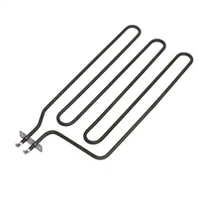
The corrosion resistance of stainless steel heating tubes is not certain, but relative and standard. At this stage, there is no steel grade that does not rust in all natural environments, whether in China or overseas. Stainless steel plate heating pipes are also unlikely to be usable in all natural environments, so they are likely to cause corrosion. Rust spots not only harm the appearance for a long time, but also reduce the service life due to the corrosion of the surface of the stainless steel pipe. The rust spots on the surface of the stainless steel pipe should be handled properly. Today, everyone will talk about how to deal with the rust spots on the heating tube?

Organic chemistry method:
Use a sprayer or pickling paste to assist the rusted location to be passivated again to produce a chromium oxide plastic film, so that it can repair the anti-corrosion ability again. Wipe the pickling paste on the surface that must be resolved. The thickness of the coating is 0.5-2 mm. The general reaction speed is more than 3 to ten minutes. When it is used below 0°C or where the air oxide is thin, it needs a moderate extension of time. In the treatment method, use a soft brush to clean it for several times. After the surface oxide scale is completely eliminated, rinse it with water (lime slurry or edible alkali is stronger) to prevent rust back. After pickling passivation, in order to better remove all air pollutants and acid residues, it is very important to carry out moderate cleaning with clean water. After everything is resolved, use a polishing machine to polish and polish again, and use polishing wax to seal it. For parts with mild rust spots, you can also use 1:1 car gasoline or car oil solution to wipe off the rust spots with a clean towel.
Mechanical equipment method:
Sandblasting treatment to remove, use laminated glass or porcelain particles to remove, submerge, clean and polish. It is possible to use mechanical equipment to wipe away the environmental pollution caused by the previously eliminated materials, abrasive materials or submerged raw materials. All kinds of environmental pollution, especially foreign human iron particles, are likely to become the source of erosion, especially in a humid and cold natural environment. Therefore, the removal of surfaces by mechanical equipment should be carried out reliably under the dry standard. The application of mechanical methods can only remove the surface, and cannot change the corrosion resistance of the raw material itself. Therefore, it is proposed to use a polishing machine to polish and polish again after the mechanical equipment is removed, and to use a polishing wax to seal.