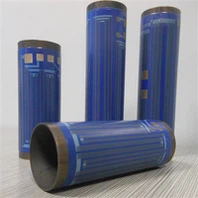
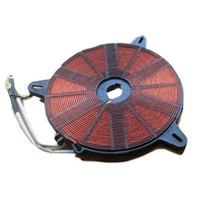
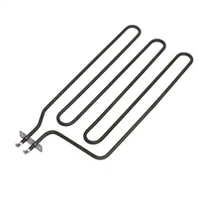
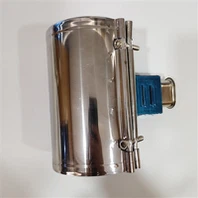
While finned heaters excel at air heating, their true performance is determined by system-level integration. The helical fin design, visible in the image, mechanically increases surface area, but optimal heat transfer requires careful attention to the thermal system beyond the heater itself. Success hinges on moving beyond simple replacement and adopting a holistic approach that considers airflow dynamics, thermal management, and mechanical integration. This ensures not only rapid heat-up but also sustained efficiency and extended operational life in demanding applications like industrial ovens, duct systems, and process air heaters.

To achieve this system-level performance, focus on these critical integration factors:
1.Orchestrating Airflow and Baffle Design: The heater's efficiency is fully realized only with optimal air velocity across the fins. Simply placing the heater in a duct is insufficient. Incorporating strategically placed baffles or guide vanes ensures laminar flow across the entire element, preventing stagnant air pockets that create hotspots and degrade the sheath material over time. This transforms a simple heating section into a high-performance thermal engine.
2.Managing Heat Density through Strategic Staging: Instead of running a single large heater at full capacity, implement a multi-stage or modulating control system. This approach activates smaller heater banks sequentially based on demand. By reducing the continuous thermal load on individual elements, staging minimizes thermal stress, leading to a longer service life and significantly lower energy consumption during partial-load conditions.
3.Ensuring Mechanical Stability to Prevent Micro-Fretting: In high-vibration environments, the constant minute movement between the heater sheath and its mounting can cause fretting corrosion, leading to premature failure. Specifying positive-lock mounting hardware and considering integrated support brackets designed for thermal expansion are essential to maintain the heater's structural integrity and consistent thermal contact over thousands of heating cycles.
By addressing these often-overlooked system integration principles-active airflow management, intelligent power staging, and robust mechanical mounting-you can unlock the full potential of finned heaters, achieving a balance of peak efficiency, unwavering reliability, and maximum longevity.