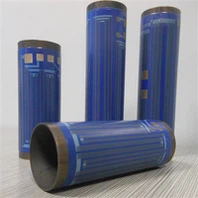
The thickness of the film in a thick film heater is controlled during the manufacturing process. Thick film heaters are created by depositing a conductive paste, usually made of metal powders suspended in a binder material, onto a substrate (such as ceramic or stainless steel) and then firing it at high temperatures to create a thick, stable film.
There are several methods used to control the thickness of this film:
1. Screen Printing: The most common method used in the production of thick film heaters is screen printing. A screen with a specific pattern is placed over the substrate, and the conductive paste is forced through the screen using a squeegee. The thickness of the film can be controlled by the mesh size of the screen, the viscosity of the paste, and the pressure applied during printing.
2. Doctor Blade Technique: In this method, a doctor blade or a similar tool is used to spread a uniform layer of conductive paste over the substrate. The gap between the doctor blade and the substrate determines the thickness of the film.
3. Spraying: Conductive paste can be sprayed onto the substrate, and the distance between the spray nozzle and the substrate, as well as the spray pressure, affects the thickness of the deposited film.
Controlling the thickness of the film is crucial for several reasons:
1. Uniform Heating: A uniform film thickness ensures even heat distribution across the heater's surface. Irregularities in thickness can lead to hotspots or uneven heating, which is undesirable in many applications.
2. Power Efficiency: A well-controlled film thickness allows for precise control of the power output of the heater. Variations in thickness can lead to differences in resistance, affecting the amount of power the heater generates for a given voltage.
3. Reliability: Consistent film thickness is essential for the reliability and longevity of the heater. Irregularities can create mechanical stress points, which might lead to cracking or delamination of the film over time.
4. Response Time: Uniform thickness ensures consistent thermal conductivity, which is vital for the heater's response time. Variations in thickness can affect how quickly the heater reaches the desired temperature.
In summary, the controlled thickness of the film in a thick film heater is essential to ensure uniform heating, power efficiency, reliability, and a fast response time, making it a critical parameter in the manufacturing process.