1. Core Working Principle: Resistance Heating
At its heart, an immersion PTFE heater is an electric resistance heater. It works on the fundamental principle of Joule's Law: when an electric current passes through a resistive element, it generates heat.
The formula is: Heat (Power) = I² × R
Where I is the current and R is the resistance of the heating element.

2. Layered Construction: The Key to Performance and Safety
The magic is in the materials and layered build, which transforms a simple resistive wire into a safe, durable, and corrosion-proof heater. From the inside out:
1. Resistive Heating Element: The core is a high-resistance alloy wire (typically Nickel-Chromium / Nichrome). When energized, this wire gets hot due to its electrical resistance. The wattage, voltage, and physical layout (coiled or straight) of this wire determine the heater's power output.
2. Primary Electrical Insulation & Heat Conduction Layer: The heating wire is embedded inside a compacted, highly thermally conductive Magnesium Oxide (MgO) powder. This powder has three critical functions:
- Insulation: It's an excellent electrical insulator, preventing short circuits between the heating wire and the metal sheath.
- Heat Conduction: It efficiently transfers heat from the hot wire outwards to the sheath.
- Support: It holds the heating wire firmly in the center, ensuring even heat distribution and mechanical stability.

3. Metallic Core Sheath (Inner Sheath): The MgO powder and wire are densely packed inside a stainless steel (usually 316L for corrosion resistance) or incoloy tube. This metal tube:
- Contains and compacts the MgO.
- Provides structural strength.
- Is the first surface that gets hot and begins transferring heat.
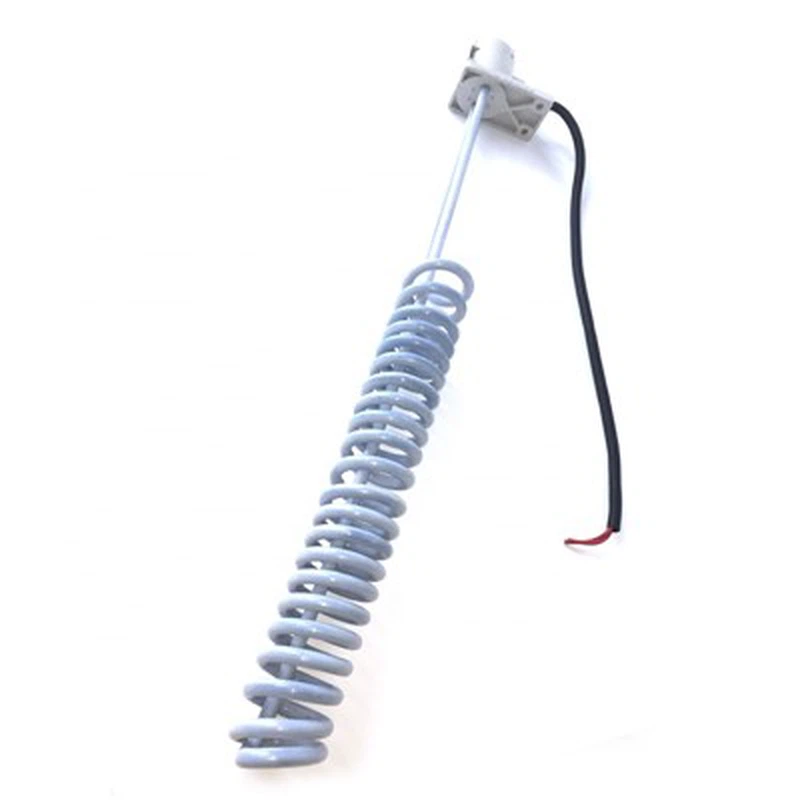
4. The PTFE Sheath (Outer Sheath): This is the defining feature. A thick layer of PTFE (Polytetrafluoroethylene/Teflon®) is permanently bonded (through a sintering process) over the metal sheath.
- Primary Role: Corrosion Barrier. The PTFE completely isolates the internal metal components from the corrosive fluid (e.g., acid/alkali slurry).
- Secondary Role: Safety Insulator. PTFE is an outstanding electrical insulator, adding a second, fail-safe layer of protection against electrical leakage.
- Tertiary Role: Non-stick Surface. It prevents scaling and allows for easy cleaning.

5. Seals & Terminations: The ends of the heater are sealed with high-quality, chemically resistant epoxy or PFA caps. These protect the electrical connections (where the power leads meet the internal element) from moisture and vapor ingress, which is critical for safety and longevity.
3. How It Works in Operation (Step-by-Step)
- Energy Input: Electrical power is supplied to the heater's terminals.
- Heat Generation: Current flows through the internal Nichrome resistance wire, causing it to heat up intensely.
- Heat Transfer (Internal): The generated heat is conducted through the MgO powder to the inner metal sheath, heating it uniformly.
- Heat Transfer (External): The heat from the metal sheath is conducted through the PTFE layer. While PTFE is not the best thermal conductor, the sheath is made thin enough to allow efficient heat transfer while still providing protection.
- Heat Exchange with Fluid: The hot outer surface of the PTFE sheath is in direct contact with the process fluid (e.g., slurry). Heat is transferred from the sheath to the fluid primarily via conduction and natural convection.
- Fluid Circulation: As the fluid near the heater warms up, it becomes less dense and rises, creating a natural circulation current that helps distribute heat throughout the tank (this can be enhanced with mechanical stirring).
4. Critical Supporting System: Temperature Control
- An immersion heater doesn't work in isolation. For safe and precise operation, it is always part of a system:
- Temperature Sensor: A separate thermocouple or RTD probe (often also PTFE-sheathed) is immersed in the fluid to monitor its temperature.
- Temperature Controller: This electronic device (often a PID controller) receives the temperature signal from the sensor. It compares the actual temperature with the desired setpoint.
- Power Regulation: Based on this comparison, the controller switches the power to the heater on or off (using a relay/contactor) or modulates it (using an SCR). This prevents overheating, maintains a stable temperature, and protects both the heater and the tank contents.
Summary: The Analogy
Think of an immersion PTFE heater like a sealed, armored, and Teflon-coated electric kettle element.
The resistance wire is the heat source (like the kettle's coil).
The MgO and metal sheath efficiently contain and transfer that heat.
The PTFE coating is the ultimate protective suit that allows it to survive in incredibly harsh chemical baths that would instantly destroy a standard metal element.
The controller is the intelligent thermostat that ensures it doesn't boil over.
Its core function is to convert electrical energy into thermal energy and deliver that energy safely and reliably into a hostile chemical environment.