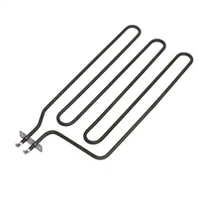
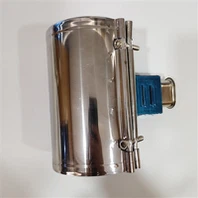
Working Principle – A Trio of High-Efficiency Thermal Energy
The working process of a flange heating tube can be viewed as a three-part process of efficient and precise energy conversion and transfer.
Point 1: The Core Conversion from Electrical Energy to Thermal Energy (Heat Source)
Core Component: Located at the innermost part of the heating tube is a top-grade resistance wire made of nickel-chromium or iron-chromium-aluminum alloy. When current passes through this resistance wire, it encounters enormous resistance, thus efficiently and directly converting electrical energy into heat energy. This is like a "congested electronic highway," where friction generates heat, producing a stable high temperature.
Point 2: High-Efficiency Insulation and Heat Conduction (Energy Transfer)
- Key Medium: The enormous heat generated needs to be safely and effectively conducted away. Between the resistance wire and the metal sheath, we fill with high-purity, high-density crystalline magnesium oxide powder (MgO).
- Dual Function: Superior Insulation: It ensures that the current is completely confined to the resistance wire, preventing leakage to the outer casing and ensuring operational safety.Superior thermal conductivity: It can transfer the high-temperature heat energy generated by the resistance wire to the outer metal sheath tube almost without loss and uniformly. This is the key to efficient heat output.
Point 3: Final heat transfer to the medium (heat exchange)
- Final step: The metal sheath tube, heated to a high temperature (depending on the medium, materials such as 304, 316L, and titanium can be selected), is directly immersed in the liquid medium to be heated (such as water, oil, acid, alkaline solutions, etc.).
- Heat exchange methods: Primarily through two methods: "heat conduction" and "heat convection". The tube wall conducts heat to the contacting liquid, and then, due to the temperature difference, the liquid will form natural or forced convection, ultimately causing the liquid temperature throughout the container to rise uniformly, achieving the preset heating target.

Part Two: Superior Advantages – Why JAYE Flange Heating Element is Your Wise Choice?
Based on the aforementioned precise working principle, JAYE flange heating elements exhibit the following five core advantages:
Advantage 1: Robust Structure, Pressure-Resistant and Durable
The flange and heating element body are welded or integrally molded, resulting in a compact structure and high mechanical strength. It can easily withstand the pressure inside the container and the impact of water flow, making it suitable for various harsh industrial environments.
Advantage 2: Extremely High Thermal Efficiency, Energy-Saving and Economical
Because the heating element is directly immersed in the medium, heat is directly transferred to the liquid with minimal intermediate losses, achieving a thermal efficiency of over 95%. Compared to traditional indirect heating methods (such as steam coils), this significantly reduces energy consumption and saves operating costs.
Advantage 3: Uniform Heating, Precise Temperature Control
Multiple U-shaped or W-shaped heating elements are evenly distributed in the container through flanges. Combined with a scientifically designed power output, this avoids localized overheating and ensures uniform heating of the liquid. Temperature sensors and control systems can be easily integrated, achieving precise temperature control of ±1~2℃, which is crucial for processes requiring strict temperature control.
Advantage 4: Safe and Reliable, Multiple Protections
JAYE provides you with multi-layered safety protection:
- Anti-Dry-Burning Design: Can be equipped with a built-in temperature controller or fuse to automatically cut off power when the liquid level is too low or during abnormal operation, fundamentally eliminating dry-burning accidents.
- Grounding Protection: Standard grounding terminal design ensures electrical safety.
- Corrosion-Resistant Materials: Special alloy materials are selected for corrosive media, effectively extending service life and preventing pipe corrosion and perforation.
Advantage 5: Easy Installation and Maintenance, Long Service Life
Flange connections only require bolts to the corresponding flange on the container, making installation and disassembly extremely convenient. When cleaning the container or replacing/repairing the heating element, there is no need to empty the entire tank, greatly reducing maintenance difficulty and time costs. Its robust design and high-quality materials ensure an exceptionally long service life.

In conclusion:
The above analysis demonstrates that a high-quality flange heating element is a precision industrial product integrating electrothermal conversion, efficient heat conduction, and a robust structure. JAYE-HEATER, with its extensive industry experience and stringent manufacturing standards, maximizes every advantage, committed to providing you with the most stable, economical, and safe industrial heating solutions.