Heating a large volume of air efficiently and uniformly is a fundamental challenge in industrial thermal processing. Finned tubular heaters are the preferred solution due to their optimized design, which directly addresses the limitations of bare elements.

Here's how they work:
1. The Core Problem: Air is a Poor Heater Transfer Medium
Low Thermal Conductivity: Air has very low density and thermal conductivity compared to liquids or metals. A bare tubular element would have to be extremely hot to transfer significant heat, leading to inefficiency and element burnout.
The Solution: Maximize Surface Area. This is where the fins come in. By adding aluminum or stainless steel fins to the tubular sheath, the surface area exposed to the air is increased by 5 to 10 times (or more). This allows a much larger volume of air to contact the heated surface simultaneously.
2. Engineering for Efficient and Uniform Heat Distribution
Turbulence and Airflow Management: The fins are not just flat disks. They are often corrugated or star-shaped. This design deliberately disrupts laminar airflow, creating turbulence. Turbulent flow breaks up the insulating boundary layer of hot air around the element and forces more mixing, leading to a much more consistent temperature throughout the oven chamber.
Watt Density Management: The large surface area of the finned heater allows it to operate at a much lower sheath temperature for a given kW output (lower watt density) than a bare element. For example, to achieve a 150°C air temperature, a bare element might need to glow red-hot at 700°C+, while a finned element's sheath might only be at 300°C. This lower operating temperature drastically extends the heater's lifespan and improves safety.
3. Mechanical Advantages for Industrial Applications
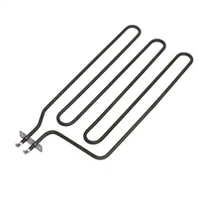
Customizable Layouts: Finned tubular heaters can be bent into various shapes (U, W, serpentine) and arranged in strategic patterns (staggered, inline) within the plenum or airflow path. This ensures the entire air volume is heated evenly, eliminating cold spots that would ruin a batch of product.
Robust Construction: The tubular sheath (typically Incoloy or stainless steel) protects the internal resistance wire and magnesium oxide insulation from vibration, physical impact, and corrosive atmospheres common in industrial settings (e.g., from solvents or moisture in drying processes).