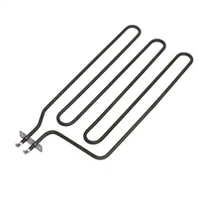
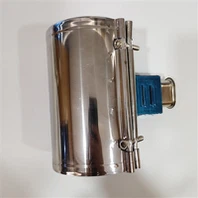
Choosing the right mica heater specifications is a systematic process that balances thermal requirements, environmental conditions, and integration constraints. Mica heaters are valued for their thin profile, fast thermal response, even heat distribution, and ability to reach high temperatures (up to 600°C+ for some types).

Here's a step-by-step guide to selecting the right specifications for different industrial needs.
Step 1: Define the Core Thermal Requirements
This is the foundation of your selection.
Target Temperature: What is the desired temperature of the object or surface being heated? (e.g., 80°C for drying, 350°C for plastic sealing).
Heat-Up Time: How quickly must the target be reached? Faster times require higher watt density.
Operational Wattage: The steady-state power needed to maintain temperature, accounting for heat losses. This is often calculated.
Watt Density (Critical Spec): This is watts per square inch (W/in²) or watts per square centimeter (W/cm²). It determines how "hot" the heater surface will be.
Low (5-15 W/in²): For gentle heating, maintaining temperatures, or heating materials like plastics with low thermal tolerance.
Medium (15-25 W/in²): Common for process heating, packaging equipment, and food warmers.
High (25-50+ W/in²): For fast heat-up, high-temperature processes, or heating metals. Requires careful design to avoid damaging the mica or element.
Step 2: Analyze the Application & Environment
The "where and how" dictates key design choices.
Duty Cycle: Will it run continuously or cycle on/off? Continuous duty may require derating (selecting a slightly lower watt density) for longevity.
Heat Transfer Method:
Conduction (Contact Heating): The heater is clamped or pressed against a surface (e.g., platen, nozzle, mold). Requires excellent flatness and surface finish for efficient heat transfer. Thermal interface paste or high-temperature pads are often used.
Radiation: The heater faces the target without contact (e.g., in an oven). The heater surface may be treated (e.g., oxidized, gold-coated) to increase or decrease emissivity.
Convection (Air Flow): Used for air heating or duct heating. Requires sufficient surface area so the element doesn't overheat. Open coil mica heaters are often ideal here.
Ambient Conditions: Is the environment corrosive, humid, dusty, or subject to washdowns? This determines the type of protective sheath.
Available Space/Form Factor: What are the dimensional constraints? Mica is very flexible for custom shapes (round, rectangular, complex cutouts).

Step 3: Specify Key Design & Construction Elements
Based on Steps 1 & 2, you can now define the heater's physical specs.
Core Type:
Pressed Mica (Muscovite): Most common. Good for flat, stable surfaces. Excellent dielectric strength.
Micanite (Built-up Mica): More flexible and resilient to thermal cycling, better for uneven surfaces.
Resistance Wire (Element):
Nickel-Chromium (NiCr): Standard choice for most applications (up to ~1150°C element temperature).
Iron-Chromium-Aluminum (FeCrAl): Can reach higher temperatures, longer life, but more brittle.
Geometry: Ribbon wire offers greater surface area and lower watt density than round wire for the same power.
Sheathing/Finishing:
Bare Mica: For clean, dry, non-contact environments. Provides fastest thermal response.
Stainless Steel Clad (e.g., 304 or 316SS): Standard protection against physical damage, mild corrosion, and oxidation. Adds thermal mass and slightly slows response.
Galvanized or Mild Steel: For lower-cost, dry environments.
Specialty Cladding: Incoloy for high-temp corrosion resistance, copper for excellent conductivity in semiconductor tools.
Terminations & Lead Wires:
Material: Must withstand temperature at the connection point. Options include nickel-plated copper, stainless steel, or fiberglass-insulated high-temp wire.
Location & Type: Spade terminals, screw terminals, or insulated leads. Ensure they are placed away from hottest zones.
Step 4: Integration & Controls
A heater cannot work in isolation.
Mounting: Specify needed holes, clamps, or brackets. For conduction, even pressure is critical.
Thermal Insulation/Reflection: Insulating the backside of the heater dramatically improves efficiency and protects surrounding components.
Sensing & Control: A thermocouple or RTD sensor is almost always required. Specify its type (J, K, PT100) and precise location (embedded in a sheath, on the heater surface, or in the target material). This is crucial for accurate temperature regulation and safety.
Power Controller: A simple thermostat, PID controller, or SSR-based system must be matched to the heater's voltage and wattage.

One-stop Heating & Controllers Factory in China
Upgrade your heating systems with Jaye Heater's premium components. For reliable heating elements and precise thermal controllers that ensure performance and safety, contact our experts today for a quote and technical support. Let's find your perfect heating solution.