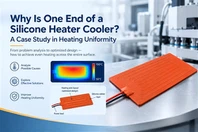
Uneven heating is one of the common challenges in large-area and custom silicone rubber heaters. In some applications, the center of the heated surface reaches the target temperature while the edge or end remains noticeably cooler.
Simply increasing the total wattage is not always the right solution.
A better approach is to examine the heater's wattage distribution, heating wire layout, surface contact, and heat-loss conditions.

The Challenge: Uneven Temperature Distribution
For a flexible silicone heater, the electrical power is converted into heat through a resistance element embedded inside the silicone rubber.
However, the final temperature distribution depends on more than total wattage.
The following factors can affect heating uniformity:
- Heating wire layout
- Watt density
- Effective heating area
- Distance between heating wires
- Contact between the heater and the heated surface
- Heat loss at edges and exposed areas
- Thermal conductivity of the heated object
- Sensor position and temperature control
This means that a 500 W heater does not automatically produce the same temperature at every point of its surface.
Solution 1: Distribute Wattage According to the Heating Requirement
One proven approach is to distribute the heating power according to the thermal requirements of the application.
In a documented silicone heater application for fluid warming, Durex Industries used a low-watt-density silicone rubber heater with distributed wattage to achieve uniform heating while avoiding excessive local temperatures. The heater was integrated with a conductive housing to improve heat transfer.
This demonstrates an important design principle:
Uniform heating does not necessarily mean maximum wattage. It means putting the appropriate amount of heat in the appropriate location.
For applications where the end or edge loses more heat, the heating pattern can be adjusted instead of simply increasing the total power.
Solution 2: Optimize the Heating Wire Layout
The resistance wire inside a silicone heater can be arranged according to the required heating area.
For large or irregular surfaces, the heating pattern does not have to remain completely uniform.
A published 2026 study on silicone heating plates investigated temperature non-uniformity by rearranging the internal heating wires. The researchers used finite-element analysis to evaluate the temperature field and then validated the optimized design experimentally. The reported heater plate was 595 × 1220 mm, with each silicone layer measuring 1.125 mm thick.
This provides a practical engineering lesson:
The internal heating-element layout is a major factor in temperature uniformity.
If one section of a heater consistently runs cooler, changing the wire distribution can be more effective than simply increasing the overall wattage.
Solution 3: Improve Contact Between the Heater and Heated Surface
Even when the heater itself is correctly designed, poor contact can create temperature differences.
Air gaps, uneven surfaces, inconsistent adhesive layers, or incomplete attachment can increase thermal resistance between the heater and the heated object.
A Durex case study involving an aluminum vessel specifically identified trapped air between the silicone heater and the vessel as a concern because it could affect temperature uniformity and heater life. Their solution included changing the heater to a two-piece design and factory-vulcanizing it to the aluminum vessel, eliminating voids and improving surface contact.
This is an important distinction:
A temperature-uniformity problem is not always a heater problem. It can also be a heat-transfer problem.
Solution 4: Use Multiple Heating Zones When Necessary
For larger or more complex surfaces, a single uniform heating zone may not provide the best result.
Custom silicone heater manufacturers can use multiple heating zones or different watt-density areas.
Birk Manufacturing, for example, lists multiple heat zones and shaded watt densities among its customization options and states that its flexible heaters can be designed for heat distribution as precise as ±0.1°C, depending on the application.
This approach is useful when different areas of the heated object have different heat-loss conditions.
For example:
High heat loss area → higher local heat input
Low heat loss area → lower local heat input
Instead of forcing the entire heater to use the same power density, the heater can be designed around the actual thermal requirements.
A Practical Design Approach
When a silicone heater shows a cooler area near the end or edge, the troubleshooting process can follow four steps:
1. Measure the actual temperature distribution
Use multiple temperature points or thermal imaging rather than checking only one sensor location.
2. Identify the cold area
Determine whether the temperature drop occurs at the edge, corner, terminal area, or another specific location.
3. Check the heat-transfer conditions
Inspect surface contact, mounting pressure, adhesive, insulation, and possible air gaps.
4. Optimize the heater design
Depending on the results, the solution may involve:
- Adjusting the heating wire layout
- Changing local watt density
- Extending the effective heating area
- Dividing the heater into multiple zones
- Improving surface contact
- Relocating the temperature sensor
The Key Lesson
A silicone heater with uneven temperature distribution should not automatically be redesigned with higher total wattage.
The more effective solution is usually to understand where the heat is needed and how heat is being transferred.
Published industrial cases show that distributed wattage, optimized heating-element layouts, improved surface contact, and multi-zone designs can all be used to improve temperature uniformity.
For custom silicone heaters, the goal is therefore not simply:
"How many watts do we need?"
It is:
"How should those watts be distributed across the heating area?"
That is often the difference between a heater that simply gets hot and a heater that delivers a controlled and uniform thermal result.

One-stop Silicone Rubber Heater Factory in China
Send your inquiry about cosmetic tubes to us and experience the transformative power it can have on your business.