
Food warming equipment needs to provide stable heat without taking up too much space. For takeaway counters, food warming tables and restaurant serving stations, silicone heating pads and aluminum foil heaters are both commonly considered.
The right choice depends on the structure of the equipment, heating area, installation method and required temperature.
Silicone Heating Pads
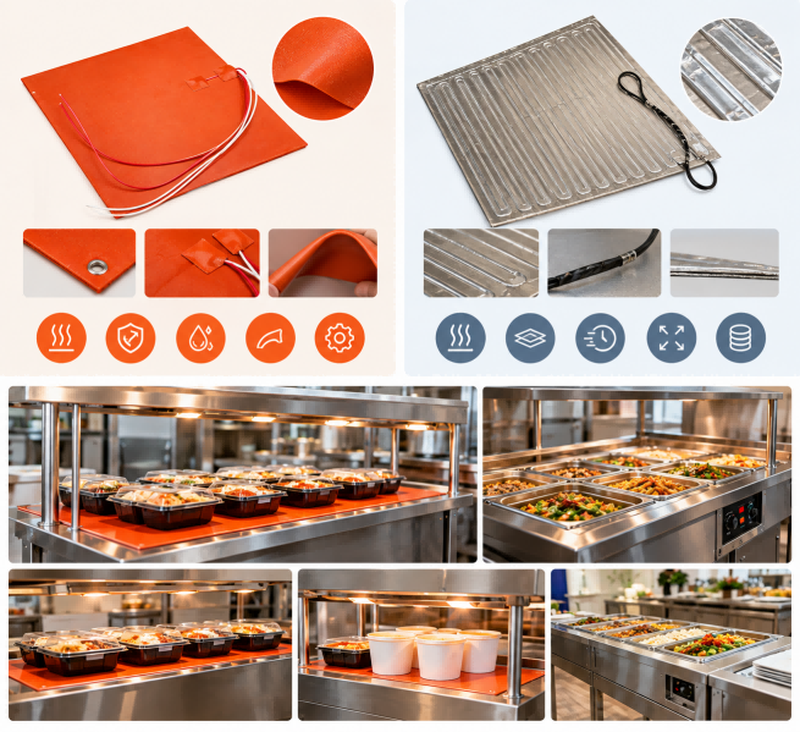
Silicone heating pads use resistance wire embedded in a flexible silicone rubber layer. They can be produced in different shapes and sizes and are often designed with mounting holes or adhesive backing.
For food warming tables, the heater can be installed underneath a stainless steel plate or another suitable heating surface.
Advantages
Flexible installation
Silicone heaters can be bent slightly to follow a curved or irregular surface. Mounting holes can also be added when the equipment requires mechanical fixing.
Good moisture resistance
The silicone insulation helps protect the internal heating wire from moisture, making this type of heater suitable for commercial food equipment where steam, splashes or regular cleaning may be present.
Easy customization
Size, voltage, wattage, lead wire position and mounting details can be customized for different food warming equipment.
Suitable for customized equipment
When a food warming table has a special shape or limited installation space, a silicone heating pad can be designed to fit the available area.
Aluminum Foil Heaters
Aluminum foil heaters generally consist of a thin heating element laminated or attached to aluminum foil. The aluminum layer helps spread heat across the surface while keeping the heater lightweight and thin.
They are particularly useful when a large, relatively flat heating area needs to be covered.
Advantages
Thin construction
The low-profile design makes aluminum foil heaters easy to install where there is limited space between the heating surface and equipment housing.
Fast heat transfer
The aluminum foil can transfer and distribute heat efficiently across the heating area, making it useful for surface warming applications.
Large-area heating
For a wide, flat food warming table, an aluminum foil heater can cover a relatively large area without adding much thickness.
Cost-effective for some applications
For simple flat heating surfaces produced in larger quantities, aluminum foil heaters can be an economical option.
Silicone vs. Aluminum Foil Heaters
| Feature | Silicone Heating Pad | Aluminum Foil Heater |
|---|---|---|
| Flexibility | Excellent | Good |
| Thickness | Thin | Very thin |
| Heat distribution | Good | Excellent for flat surfaces |
| Moisture resistance | Excellent | Good |
| Mounting holes | Easy to customize | Depends on construction |
| Large-area heating | Suitable | Very suitable |
| Irregular surfaces | More suitable | Less suitable |
| Flat surfaces | Suitable | Very suitable |
| Custom shapes | Excellent | Excellent |
| Installation | Adhesive or mechanical fixing | Usually adhesive |
| Typical use | Customized heating equipment | Large flat heating surfaces |
Which Heater Is Better for Food Warming?
There is no single heater that is suitable for every food warming application.
For a flat, large-area warming table, an aluminum foil heater can be a practical choice because of its thin construction and good heat distribution.
For a custom food delivery table with mounting requirements, a silicone heating pad may be more convenient. It can be manufactured with specific dimensions, mounting holes and lead wire configurations to match the equipment.
The heating surface also plays an important role. Both types of heaters are generally installed underneath the food warming surface, rather than being placed directly in contact with food.
What Should You Consider Before Choosing a Heater?
Before selecting a heating pad, it is useful to confirm:
- Heating area
- Table or plate material
- Required temperature
- Operating voltage
- Required wattage
- Insulation thickness
- Installation method
- Expected operating time
- Ambient temperature
For example, a stainless steel food delivery table may require a different heating solution from a small takeaway warming counter. Simply choosing a higher wattage does not necessarily result in better food warming.
Silicone or Aluminum Foil for Food Delivery Tables?
For food delivery tables, takeaway counters and restaurant warming stations, both solutions can work well when properly designed.
A silicone heating pad is often more convenient when the heater requires custom mounting holes, specific shapes or mechanical fixing.
Aluminum foil heaters are particularly useful when the application requires a thin heater covering a large, flat surface.
The final choice should therefore be based on the equipment design rather than the heater material alone.
Need a Customized Food Warming Heater?
Jaye Heater supplies customized silicone heating pads and aluminum foil heaters for food warming equipment.
We can customize the size, voltage, wattage, heating area, lead wire and mounting configuration according to your equipment requirements.
Send us your drawing or basic specifications, and we can help evaluate a suitable heating solution.

One-stop Heating & Controllers Factory in China
Upgrade your heating systems with Jaye Heater's premium components. For reliable heating elements and precise thermal controllers that ensure performance and safety, contact our experts today for a quote and technical support. Let's find your perfect heating solution.


