
1. Introduction: Why Does Watt Density Matter in Thin Film Heaters?
When selecting a thin film heater for your equipment, watt density is one of the most important parameters to evaluate. It determines how much electrical power is generated per unit of active heating area and directly influences heating speed, surface temperature, thermal uniformity, and long-term reliability.
Both JAYE and Minco offer polyimide-based flexible heating solutions for applications requiring compact structures and controlled surface heating. However, their published watt density specifications are not identical.
JAYE's published Kapton Polyimide Thin Film Heater specification lists a power density range of 0.03–2.5 W/cm², while Minco lists its Polyimide Thermofoil heaters with watt density up to 50 W/in² (approximately 7.75 W/cm²).
These figures provide a useful starting point for comparison, but they should not be treated as a direct performance ranking. Actual allowable watt density depends on heater construction, insulation, mounting conditions, operating temperature, and heat dissipation.
For OEM manufacturers, the right choice is not necessarily the heater with the highest watt density. It is the heater that delivers the required heating performance without exceeding the thermal and electrical limits of your application.
2. What Is Watt Density in a Thin Film Heater?
Watt density, also called power density or surface power density, refers to the electrical power generated per unit of active heating area.
The calculation is:
Watt Density = Total Heater Power (W) ÷ Active Heating Area (cm²)
For example, if your heater has a rated power of 50 W and an effective heating area of 100 cm²:
50 W ÷ 100 cm² = 0.5 W/cm²
This means the heater generates 0.5 watts of electrical power for every square centimeter of active heating area.
You should distinguish between total wattage and watt density:
Total wattage determines the overall electrical power consumed by the heater.
Watt density indicates how concentrated that power is across the heating surface.
Active heating area excludes non-heating margins, terminals, and other inactive sections.
A 100 W heater with a large heating area may have a lower watt density than a 50 W heater with a much smaller active area.
For this reason, comparing heaters by total wattage alone can lead to incorrect engineering decisions.
3. JAYE vs Minco: Thin Film Heater Watt Density Comparison
The following comparison uses publicly available product information. It focuses on polyimide flexible heaters rather than all heater technologies offered by either manufacturer.
| Technical Parameter | JAYE Thin Film Heater | Minco Thin Film Heater |
|---|---|---|
| Product type | Kapton Polyimide Thin Film Heater | Polyimide Thermofoil Heater |
| Heating element | Etched foil heating circuit | Etched foil heating element |
| Insulation | Polyimide film | Polyimide insulation |
| Published watt density | 0.03–2.5 W/cm² | Up to 50 W/in² (7.75 W/cm²) |
| Operating temperature | -60°C to 180°C (published product range) | Options available from -200°C to +200°C |
| Voltage | 1.5–240 V | Depends on heater resistance and design |
| Customization | Custom dimensions, shapes, wattage, and voltage | Custom shapes, sizes, heating profiles, and terminations |
| Typical design focus | Customized flexible heating elements | Standard and engineered Thermofoil heating solutions |
Important comparison note: The watt density values above are published product specifications, not guaranteed operating limits under identical test conditions. Minco's maximum allowable watt density varies with insulation, installation method, and heat sink temperature. You should request application-specific confirmation before making a final selection.
3.1 JAYE Thin Film Heater: Flexible Power Density for OEM Applications
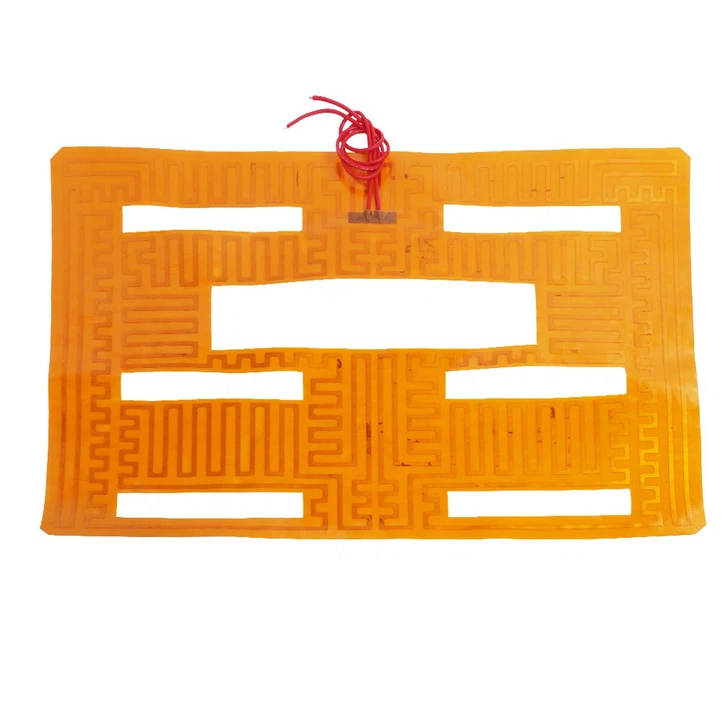
JAYE manufactures customized Kapton polyimide thin film heaters using a flexible film construction with an etched metal foil heating circuit.
According to JAYE's published product specifications, the power density range is 0.03–2.5 W/cm², with an operating temperature range of -60°C to180°C.
You can specify different heater dimensions, voltage, wattage, and lead configurations according to your equipment design.
This approach is suitable when your product requires:
A customized heating area that matches a specific component.
A thin and lightweight heating structure.
Low-voltage heating options for compact electronic equipment.
Distributed surface heating rather than concentrated point heating.
Flexible integration into limited installation spaces.
For OEM applications, the main engineering consideration is how to match the heater's power density with the thermal load, substrate material, and temperature control system.
A higher watt density may shorten warm-up time, but it also increases the importance of heat transfer and temperature monitoring.
3.2 Minco Thin Film Heater: Established Thermofoil Design Options
Minco's Polyimide Thermofoil heaters are designed for applications requiring thin, flexible, and closely coupled surface heating.
Minco publishes a maximum watt density of up to 50 W/in² for its Polyimide Thermofoil heater category. Its All-Polyimide Thermofoil products list a typical watt density of 25–50 W/in².
Minco also provides different heater insulation and installation options, including pressure-sensitive adhesive and mechanical mounting configurations for applicable products.
Its engineering documentation emphasizes that maximum allowable watt density is affected by:
Insulation material.
Internal adhesive construction.
Heat sink temperature.
Mounting method.
Effective heating area.
Minco's design guide also explains that exceeding the allowable watt density can cause overheating and premature heater failure.
This is an important point for OEM engineers: a published maximum watt density should never be treated as a universal operating recommendation.
4. How Does Watt Density Affect Thin Film Heater Performance?
Watt density influences several aspects of heater performance. However, it does not work independently of the thermal system.
4.1 Heating Speed
A higher watt density can increase the rate of heat generation per unit area.
For example, when heating a metal plate, a heater with sufficient power density may reduce the time needed to reach the target temperature.
However, actual warm-up time also depends on:
The mass and specific heat capacity of the heated component.
Thermal conductivity of the substrate.
Contact quality between the heater and heated surface.
Heat loss to the surrounding environment.
Temperature control strategy.
Therefore, increasing watt density does not automatically guarantee a proportional reduction in heating time.
4.2 Surface Temperature and Hot Spots
When you increase electrical power without improving heat dissipation, the heater surface temperature may rise.
If the heater is not properly matched to the substrate, localized hot spots can develop.
This may cause:
Uneven heating across the target surface.
Accelerated aging of insulation materials.
Adhesive degradation.
Reduced heater service life.
Temperature instability in sensitive equipment.
A well-designed etched foil pattern should distribute heat according to the thermal requirements of the application.
For components with different heat-loss areas, a profiled heating circuit or multiple heating zones may be more appropriate than a uniform power distribution.
4.3 Energy Consumption
Watt density and total energy consumption are related but not interchangeable.
A heater with higher watt density does not necessarily consume more energy over an entire operating cycle.
Energy consumption depends on total wattage, operating time, duty cycle, and temperature control.
For example, a higher-power heater may reach the target temperature faster and then switch to a lower duty cycle. Whether this reduces total energy consumption depends on the actual thermal system.
5. What Watt Density Should You Choose for Your Application?
There is no single watt density suitable for every thin film heater application.
You should determine the required power density from the heating target, thermal mass, installation method, and allowable operating temperature.
The following table provides application-oriented engineering considerations rather than universal watt density limits.
| Application | Main Heating Requirement | Watt Density Consideration |
|---|---|---|
| Battery heating | Uniform temperature distribution across battery surfaces | Avoid localized overheating; evaluate insulation and cell temperature limits |
| 3D printer heated beds | Stable and uniform heating across the build platform | Match power density to bed material, thickness, and required warm-up time |
| Medical equipment | Controlled heating for fluid paths or instrument surfaces | Prioritize temperature uniformity and independent over-temperature protection |
| LCD and electronic displays | Low-profile heating for anti-condensation or temperature maintenance | Consider low and distributed power density to protect sensitive components |
| Vacuum equipment | Controlled heating under vacuum conditions | Evaluate outgassing, thermal contact, and material compatibility |
| Industrial instruments | Stable surface temperature during operation | Match power density to heat loss and control accuracy requirements |
5.1 Battery Heating Applications
Battery heating requires controlled and relatively uniform surface temperatures.
If watt density is too high, local temperature differences may develop, especially when the heater does not cover the battery surface evenly.
For battery modules, you should evaluate the cell manufacturer's temperature limits, heater placement, insulation, and sensor locations before determining the final power density.
5.2 3D Printer Heated Beds
For a 3D printer heated bed, the heater must transfer heat evenly to the build plate.
The required watt density depends on the bed dimensions, aluminum plate thickness, target temperature, and warm-up time.
A customized polyimide heater can be designed to fit the available installation area and electrical requirements.
5.3 Medical and Laboratory Equipment
Medical and laboratory equipment often requires repeatable temperature conditions rather than simply high heating power.
In these applications, you should prioritize:
Uniform heat distribution.
Stable temperature feedback.
Electrical insulation.
Material compatibility.
Appropriate over-temperature protection.
A lower watt density with suitable temperature control may be more appropriate than a high-output heater.
6. How to Select the Right Thin Film Heater: Five Engineering Factors
When comparing JAYE and Minco, you should evaluate the complete heater design instead of focusing only on the maximum watt density.
1. Required Heating Power
Calculate the heat required by your equipment based on thermal mass, target temperature, warm-up time, and expected heat loss.
Then determine the required watt density using the effective heating area.
2. Operating Temperature
Check both the maximum heater operating temperature and the temperature of the heated component.
The insulation, adhesive, lead wires, and connection areas must all remain within their respective temperature ratings.
3. Mounting Method
Mounting has a direct influence on heat transfer.
A heater bonded to a flat metal surface may dissipate heat differently from one attached to a plastic housing or installed with mechanical clamping.
Poor contact can create localized overheating even when the nominal watt density appears acceptable.
4. Temperature Control
Determine whether your equipment requires an external temperature sensor, thermostat, or electronic controller.
For applications with changing thermal loads, closed-loop temperature control can help maintain stable operating conditions.
Over-temperature protection should also be considered where overheating could damage the equipment.
5. Electrical and Mechanical Compatibility
Check the following parameters before finalizing your heater design:
Rated voltage and total wattage.
Heater resistance and tolerance.
Active heating area.
Overall dimensions and thickness.
Lead wire type and exit position.
Insulation and dielectric requirements.
Adhesive or mechanical mounting.
Required service life and operating cycles.
These factors help you determine whether a standard heater can meet your requirements or whether a customized design is necessary.
7. Why Consider JAYE as an Alternative for OEM Thin Film Heater Projects?
If you are evaluating alternatives to Minco, the first step is to compare the technical requirements of your existing heater with the capabilities of the proposed replacement.
JAYE provides customized Kapton polyimide thin film heaters for equipment manufacturers.
Instead of selecting a replacement based only on the original heater's wattage, you can provide your existing heater specifications and application conditions for a more accurate engineering evaluation.
JAYE's customization options include:
Heater dimensions and shapes.
Voltage and wattage.
Heating circuit configuration.
Lead wire specifications.
Installation and mounting requirements.
Temperature and application requirements.
For an OEM replacement project, you should prepare the following information:
Existing heater dimensions and drawings.
Rated voltage and total wattage.
Required watt density or active heating area.
Target operating temperature.
Heated component material and thickness.
Mounting method and thermal contact conditions.
Temperature sensor and control requirements.
With these details, you can evaluate whether a JAYE heater can meet the original design requirements or whether adjustments are needed.
The objective is not simply to match the original watt density. It is to achieve compatible heating performance, electrical safety, mechanical integration, and service life.
8. Conclusion: Compare Watt Density Within the Complete Thermal System
When comparing JAYE Thin Film Heater vs Minco Thin Film Heater, watt density is an important starting point, but it should not be the only selection criterion.
JAYE publishes a power density range of 0.03–2.5 W/cm² for its Kapton polyimide thin film heater. Minco lists up to 50 W/in² (approximately 7.75 W/cm²) for its Polyimide Thermofoil heater category.
These published values indicate different specification ranges, but they do not establish which heater will perform better in your equipment.
For your OEM project, the correct selection depends on the required heating power, operating temperature, substrate material, heat transfer conditions, installation method, and temperature control strategy.
If you are looking for a customized alternative to an existing Minco thin film heater, JAYE can evaluate your drawings and technical requirements to determine a suitable polyimide heater configuration.
Share your heater dimensions, voltage, wattage, and operating conditions with JAYE to start a technical evaluation for your next OEM heating project.
9. Frequently Asked Questions (FAQ)
Q1: What is the watt density of a JAYE thin film heater?
JAYE's published Kapton Polyimide Thin Film Heater specification lists a power density range of 0.03–2.5 W/cm². The final value depends on heater dimensions, voltage, wattage, and application conditions.
Q2: What is the maximum watt density of a Minco thin film heater?
Minco lists its Polyimide Thermofoil heaters with watt density up to 50 W/in², equivalent to approximately 7.75 W/cm². This is a published product-category maximum, not a universal operating limit for every installation.
Q3: Does higher watt density mean faster heating?
Generally, higher watt density provides more electrical power per unit of heating area. However, actual heating speed also depends on thermal mass, substrate conductivity, mounting contact, and heat loss.
Q4: Can you replace a Minco thin film heater with a JAYE heater?
A JAYE polyimide heater may be evaluated as an alternative, provided its electrical, thermal, and mechanical specifications meet your application requirements. You should compare dimensions, resistance, voltage, wattage, active area, temperature limits, and mounting conditions before approving a replacement.
Q5: What happens if the watt density is too high?
Excessive watt density can cause overheating, localized hot spots, insulation deterioration, adhesive failure, and premature heater failure. You should verify the allowable watt density under actual mounting and operating conditions.
What information should you provide when requesting a customized thin film heater?
You should provide heater dimensions, voltage, total wattage, target operating temperature, heated surface material, mounting method, lead wire requirements, and temperature control specifications. A drawing or sample of your existing heater can also help the manufacturer evaluate the replacement design.
References
JAYE Heater – Kapton Polyimide Thin Film Heater
https://www.jaye-heater.com/flexible-film-heater/flexible-thin-film-heater/kapton-polyimide-thin-film-heater.html
Minco – Flexible Heater FAQ
https://www.minco.com/resources/flex-heater-faq/
Minco – Heater Selection Chart
https://www.minco.com/products/flexible-heaters/heater-selection-chart/
Minco – Thermal Solutions Design Guide
https://www.minco.com/wp-content/uploads/Minco-Thermal-Solutions-Design-Guide.pdf
Minco – Flexible Heaters
https://www.minco.com/products/flexible-heaters/


