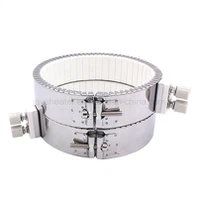
Silicone heating pads serve as the precise, safe, and efficient thermal core in food warming cabinets (e.g., buffet warmers, food delivery cabinets, home food warmers). Below are their specific functions, advantages, and implementation methods.

Core Functions
Precision Temperature Control
Maintains cabinet temperature within a set range (typically 55°C–85°C), ensuring food remains in the safe temperature zone (above 60°C effectively inhibits bacterial growth) and preventing spoilage.
Even Heat Distribution
Through large-area contact with cabinet walls or shelves, achieves uniform heat distribution, eliminating hotspots or cold zones to ensure consistent food quality.
Rapid Temperature Recovery
Quickly restores set temperature after heat loss from door openings, maintaining warming efficiency.
Moisture and Condensation Prevention
Keeps the cabinet interior dry, preventing water condensation that could affect food quality or cause electrical short circuits.

Advantages Over Traditional Heating Methods
| Comparison | Traditional Heating Wires/Tubes | Silicone Heating Pads |
|---|---|---|
| Safety | Exposed resistance wires prone to oxidation; insulation layers may degrade, risking electric leakage or short circuits. | Fully sealed silicone insulation, waterproof, corrosion-resistant, with surface insulation withstand voltage up to 2500V+, suitable for humid kitchen environments. |
| Heat Uniformity | Linear or point heat sources require fans for forced convection, often leading to uneven temperatures. | Surface-area heating ensures even temperature distribution without fans, enabling natural convection. |
| Energy Efficiency | Significant heat loss to the air results in lower thermal efficiency. | Direct contact heat transfer ensures high thermal conduction efficiency, reducing energy consumption by ~15%–30%. |
| Design & Integration | Fixed shapes, complex installation, requiring safety clearances. | Flexible and customizable-can be trimmed to fit curved surfaces or the back of shelves, enabling hidden installation and space savings. |
| Temperature Control Accuracy | Slow response with larger temperature fluctuations (±5°C or more). | Fast thermal response; when paired with high-precision controllers (e.g., PID), temperature fluctuations can be controlled within ±1°C. |
Typical Application Solutions
Sidewall/Back Panel Heating
Pads are attached to the inner side of metal side or back panels, providing even heating through radiation and natural convection.
Advantages: Simple structure, easy maintenance; suitable for large warming cabinets.
Shelf Bottom Heating
Pads are embedded beneath each stainless steel food shelf, enabling direct top-down heat conduction.
Advantages: Highest thermal efficiency; each shelf can be independently controlled (e.g., upper shelf for high-temperature, lower shelf for low-temperature).
Combined Heating Mode
Sidewall heating + bottom auxiliary heating, ideal for scenarios requiring extreme temperature stability (e.g., medical meal delivery cabinets).
With their flexibility, safety, uniformity, efficiency, and ease of integration, silicone heating pads significantly enhance the temperature precision, energy efficiency, and safety standards of food warming cabinets, making them an indispensable heating component in modern smart foodservice equipment.
Jaye Heater offers customized solutions: Based on your cabinet structure, warming requirements (temperature range, heating speed, zoning needs), and safety standards (e.g., CE/UL certification), we design and produce compatible silicone heating pads and temperature control systems to ensure optimal performance. Feel free to provide specific parameters for a tailored solution.

One-stop Heating & Controllers Factory in China
Upgrade your heating systems with Jaye Heater's premium components. For reliable heating elements and precise thermal controllers that ensure performance and safety, contact our experts today for a quote and technical support. Let's find your perfect heating solution.