1. Introduction
Global carbon emission regulations and fossil fuel depletion have driven the automotive industry's shift to electric vehicles (EVs), which offer high energy efficiency and near-zero greenhouse gas emissions.
Unlike internal combustion engine (ICE) vehicles, EVs generate negligible waste heat, making dedicated heating systems a necessity-high-voltage positive temperature coefficient (HV-PTC) heaters have emerged as the primary solution due to their high heating capacity, fast response, and reliability.
Conventional low-voltage PTC heaters (≤1 kW) served only as auxiliary heating for ICE vehicles, but EVs require HV-PTC heaters with a heating capacity of 5 kW or more, paired with battery voltage specifications of over 330 V.
This study focuses on the heating performance of HV-PTC heaters under real-world operating conditions and structural optimization to enhance their output density and efficiency, a critical factor for extending EV driving range.

2. Design of High-Voltage PTC Heater Prototypes
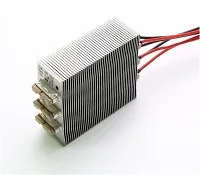
Two HV-PTC heater prototypes (Heater A: base model; Heater B: enhanced model) were designed for integration into EV HVAC systems, with four modular heat cores (each with three heat rods and radiation fins) as the core structure. The key design difference lies in the radiation fin, the dominant factor for airside thermal resistance. Heater A adopted a plate fin (2.0 mm pitch, 0.4 mm thickness, 501.1 mm² heat transfer area, 1.8 kg weight), while Heater B featured an emboss fin (1.6 mm pitch, 0.3 mm thickness, 507.6 mm² heat transfer area, 1.6 kg weight). The emboss fin design induces airflow turbulence to boost heat transfer, and the reduced fin thickness cuts weight by ~13% while increasing the heat transfer area. Both prototypes share the same overall dimensions (200×210×28 mm³) and rated input voltage (330 V), ensuring compatibility with standard EV HVAC layouts.
3. Experimental Setup and Test Methodology
A closed-loop test system compliant with ASHRAE standards (37, 41.2, 51) was constructed to evaluate HV-PTC heater performance, consisting of an air channel, environment chamber, 500 V/30 A DC power supply, and 60-channel data acquisition system (DAQ).
Key sensing components included K-type thermocouples (±0.1% accuracy) for inlet/outlet temperature measurement, a differential pressure sensor (±0.14% full scale) for pressure drop testing, and a Pitot tube for airflow rate calculation.
Standard test conditions were defined as 300 kg/h airflow, 0 °C ambient temperature, and 330 V input voltage; additional tests were conducted across variable airflow (100–500 kg/h), inlet temperature (0–20 °C), and input voltage (240–330 V). Steady-state operation was confirmed when current variation was ±0.05 A and temperature variation ±0.1 °C, with data collected at 1-s intervals for 10+ minutes for averaging.
4. Performance Characteristics Under Variable Operating Conditions
HV-PTC heater performance was evaluated by heating capacity, efficiency, pressure drop, and gravimetric power density, with three key findings from variable condition tests:
- Airflow rate: At 0 °C/330 V, heating capacity rose from ~3 kW to 5.2 kW as airflow increased from 100 to 500 kg/h (with a diminishing growth rate), while efficiency improved from 83.8% to 96.6%; pressure drop increased linearly with airflow due to higher airside resistance.
- Inlet temperature: At 300 kg/h/330 V, heating capacity decreased by 0.35 kW (0–20 °C) due to reduced convection heat transfer, but efficiency increased as overall thermal resistance of the heater declined.
- Input voltage: At 0 °C/300 kg/h, heating capacity increased slightly with voltage (240–330 V), efficiency remained stable at 95–96%, and input current decreased markedly-balancing power consumption and heating performance.
5. Structural Optimization and Improved Prototype Evaluation
Four physical models were analyzed via Ansys Fluent (Realizable κ-ε model) to optimize fin geometry: Case 1 (base plate fin), Case 2 (reduced fin pitch), Case 3 (reduced fin thickness), Case 4 (emboss fin).
Thermal flow analysis showed Case 2 increased heating capacity by 7.1%, Case 3 reduced it by 5.1%, and Case 4 improved it by 4.8% (with pressure drop within HVAC system limits).
Heater B (the optimized emboss fin prototype) was tested and compared to Heater A: it achieved a heating capacity of 5.52 kW (+10% vs. A), efficiency of 98% (+2.3% vs. A), and gravimetric power density of 3.45 kW/kg (+24% vs. A).
While its pressure drop (48.2 Pa) was higher than Heater A (40.4 Pa), the value was within the allowable range for EV HVAC blowers, with no measurable impact on system operation.
6. Conclusions and Future Outlook
This study verifies that structural optimization of radiation fins-specifically emboss shaping, reduced pitch, and thinner design-significantly enhances the heating performance and gravimetric power density of HV-PTC heaters for EVs.
The improved prototype (Heater B) delivers 5.52 kW heating capacity, 98% efficiency, and 3.45 kW/kg power density, addressing the core demand for high-efficiency heating while reducing weight to extend EV driving range.
The emboss fin design is proven to be a practical optimization strategy, as it boosts heat transfer via airflow turbulence without compromising HVAC system compatibility.
Future research will focus on optimizing additional heater components (e.g., heat rods, insulators) and developing a correlation formula between heat transfer, pressure drop, and dimensionless design parameters.
Further experiments under extreme low-temperature conditions (-20 °C to 0 °C) will also be conducted to validate HV-PTC heater performance in cold climates, a key consideration for global EV deployment.

One-stop PTC HEATERS Factory in China
If you require heating elements, Jaye Heater-as a long-standing manufacturer of heating elements-will assist you with our team of professional technicians and sales personnel.