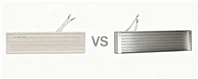
The core difference lies in the heating element material and the radiated wavelength, which determines their heating speed, efficiency, and ideal applications.
In short: Ceramic heaters are "long-distance runners" (slower start, uniform heat, long life). Quartz heaters are "sprinters" (instant heat, high temperature, more fragile).
Here is a clear comparison table:
| Feature | Ceramic Infrared Heater | Quartz Tube/Plate Heater |
|---|---|---|
| Core Material | Ceramic element with embedded resistance wire | Quartz glass tube/plate with internal resistance or tungsten wire |
| Radiated Wavelength | Long-wave IR (2-10µm). Good penetration, heats thick objects uniformly. | Medium/Short-wave IR (0.78-3µm). High energy density, very fast heating. |
| Heat-up Speed | Slow to medium. Requires warm-up time. Low thermal inertia. | Extremely fast. Short-wave types react in seconds. |
| Operating Temp. | Medium range, typically 300°C – 800°C (572°F – 1472°F) | Wide range, low to very high. Can exceed 1500°C (2732°F). |
| Key Advantages | 1. Durable & rugged, corrosion-resistant. Long life (up to 20,000 hrs). 2. Uniform heating, high emissivity (>90%). 3. No bright light (dark red or invisible glow). |
1. Instant on/off, very fast thermal response (<20 sec). 2. Chemically stable, no contamination. 3. High power density and heating efficiency. |
| Key Disadvantages | Slower heat-up; not suitable for rapid cycling. | 1. Fragile (glass), prone to breakage. 2. Produces intense, bright light. 3. Extremely high surface temperature (burn risk). |
| Typical Applications | Plastic processing, chemical fiber manufacturing, uniform industrial heating, low-light environments. | Rapid heating processes, food drying, space heaters, applications needing fast temperature ramp-up. |
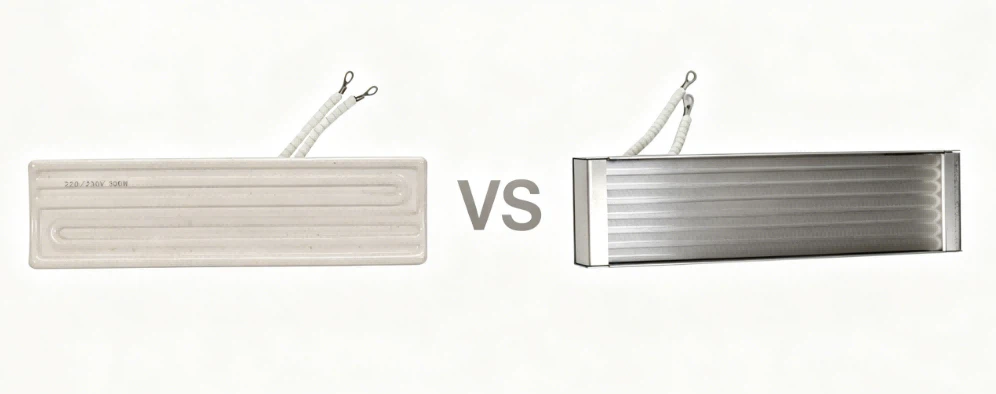
How to Choose – Practical Advice
Based on your process needs
Need stable, uniform heating and long-term durability (e.g., plastics, chemicals)? → Ceramic heater. Its long-wave IR penetrates plastics evenly.
Need instant, high-speed heating (e.g., intermittent production lines, fast drying)? → Quartz heater.
Based on environment & safety
High vibration or bump-prone area → Ceramic heater (more rugged).
Light-sensitive environment (darkrooms, no glare allowed) → Ceramic heater (minimal glow). Quartz produces bright light.
Based on total cost
Quartz heater – Lower upfront cost, but may need frequent replacement.
Ceramic heater – Higher initial cost, but longer lifespan and potential 15-30% energy savings over traditional heaters → lower long-term cost.
Whether you need the rugged durability of ceramic or the rapid response of quartz, we have the right infrared heater for your specific process. Contact us today for expert advice and a competitive quote. Let us help you optimize your heating efficiency.