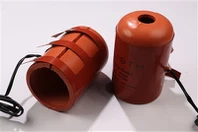
Food processing plants increasingly choose custom silicone heating pads over traditional metal-jacketed hoppers for several compelling reasons related to food safety, efficiency, product quality, and operational cost:
1-Superior Temperature Uniformity & Control (Critical for Food Safety & Quality):
Metal (Poor Conductor for Uniform Heating): While metal conducts heat fast, it also creates significant hot spots near the heat source (like steam jackets or electric bands) and cold spots elsewhere. This unevenness is a major food safety hazard (bacterial growth in cold zones) and causes product degradation (burning, caramelization, protein denaturation) in hot zones.
Silicone (Intelligent Insulator/Heater): Silicone pads act as large-area, flexible radiant heaters. They distribute heat far more evenly across the entire hopper surface. This eliminates dangerous cold spots where pathogens can thrive and prevents localized overheating that damages product texture, flavor, or nutritional value. Consistent temperature is paramount for sensitive foods (dairy, sauces, chocolate, fats).
2-Enhanced Food Safety & Hygiene:
Seamless, Non-Porous Surface: High-quality food-grade silicone forms a seamless, non-porous barrier that is inherently resistant to microbial growth and easy to clean/sanitize (CIP compatible). It lacks the cracks, crevices, and welds found in metal jackets where biofilms can harbor dangerous bacteria (Listeria, Salmonella, E. coli).
Corrosion Resistance: Silicone is completely immune to corrosion from acids, salts, caustic cleaners, and food products themselves. Metal jackets, especially welds, are prone to rust and pitting over time, creating contamination risks and harborage points.
Non-Toxic & Compliant: Premium food-grade silicones meet strict FDA, EU, NSF, and 3-A standards, ensuring no leaching of harmful substances into food. Metal liners require specific coatings (potential wear) or alloys (costly) to achieve similar safety.
3-Prevention of Product Burn-On & Sticking:
Even Heat = Less Burning: The uniform, lower peak temperatures achieved with silicone drastically reduce the risk of product scorching or burning onto the hopper wall compared to intense localized hot spots on metal.
Release Properties: Silicone inherently has excellent non-stick properties, further minimizing product adhesion and buildup, which is a major sanitation and product waste issue with sticky foods (doughs, cheese, syrups, nut butters).
4-Energy Efficiency & Operational Cost Savings:
Reduced Heat Loss: Silicone itself acts as an insulator. Once the hopper wall reaches temperature, silicone pads lose significantly less heat to the surrounding environment compared to highly conductive metal jackets, especially uninsulated ones.
Lower Peak Temperatures Needed: Achieving the same effective product temperature often requires lower set-point temperatures on the silicone heater controller than on a metal jacket system because there are no cold spots to compensate for. This directly saves energy.
Faster Response & Better Control: Modern silicone heaters with integrated sensors offer precise PID control, minimizing temperature overshoot and cycling, further optimizing energy use.
5-Durability & Reduced Maintenance:
Resistance to Damage: Silicone is highly resistant to impact, abrasion, and thermal shock (rapid temperature changes) that can crack or warp metal. It won't dent.
No Corrosion: Eliminates the constant battle against rust, pitting, and coating degradation seen in metal hoppers exposed to wet, corrosive food environments and aggressive cleaning chemicals. This drastically reduces maintenance downtime and replacement costs.
Flexibility: Absorbs vibration and minor structural flexing without cracking or failing, unlike rigid metal.
6-Condensation Control (Critical for Hygroscopic Products):
Eliminating Cold Spots: By maintaining a uniformly warm surface temperature, silicone pads prevent the formation of condensation inside the hopper. Condensation is a major problem for powders (sugar, flour, milk powder, starches) and hygroscopic materials, causing clumping, bridging, spoilage, and microbial growth. Metal hoppers struggle immensely with this.
7-Installation & Safety:
Lightweight & Flexible: Silicone pads are much lighter and easier to handle and install than heavy metal jackets or cladding, especially on large or existing hoppers. They conform perfectly to complex shapes.
Safer Surface Temperatures: The outer surface of a well-designed silicone heating pad remains much cooler to the touch than a steam-jacketed or directly heated metal surface, reducing burn risks for workers.