When it comes to choosing heating solutions, the debate between polyimide (PI/Kapton) heater pads and silicone heater pads is a common one for engineers and product designers. The key to a successful application lies in matching the heater's properties to your operating environment and requirements-neither option is universally superior, but each shines in distinct scenarios. Below is a detailed comparison to help you make an informed decision, along with critical technical insights and application guidelines.
Core Characteristics: PI Heater Pads
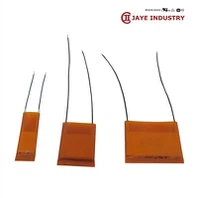
Polyimide heater pads, often referred to by the brand name Kapton, are thin, flexible, and translucent heating elements crafted from high-performance polyimide film. Their design incorporates etched alloy foil as the heating component, a feature that delivers two major advantages: uniform heat distribution across the entire surface and a faster thermal response compared to traditional wire-wound heating structures.
Physically, these pads stand out for their ultra-slim profile (typically 0.1–0.3mm thick) and lightweight construction, making them ideal for applications where space and weight are at a premium-such as 3D printers, compact electronic devices, or aerospace components. They also boast exceptional electrical insulation (insulation resistance ≥100MΩ) and chemical resistance, thriving in harsh environments involving vacuum, oils, radiation, or certain corrosive substances.
In terms of technical specifications, PI heater pads support a wide voltage range (1.5V–400V AC/DC), operate within a temperature spectrum of -185°C to 380°C (with long-term use recommended below 180°C), and offer a power density range of 0.03W/cm² to 6.5W/cm². Installation is straightforward, with pressure-sensitive adhesive (PSA) backing as a standard option, or custom mechanical mounting holes available upon request.
Core Characteristics: Silicone Heater Pads
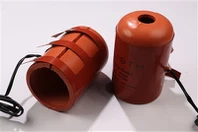
Silicone heater pads are flexible heating elements composed of high-temperature-resistant silicone, fiber-reinforced materials, and metal heating circuits. Unlike PI pads, they offer greater versatility in thickness (starting from 1mm, with adjustable ranges) and excel in scenarios requiring durability in exposed or harsh weather conditions. Their silicone-based insulation provides excellent weather resistance and anti-aging properties, significantly extending service life even in outdoor or rugged industrial settings.
Technically, silicone heater pads support similar voltage ranges (up to 380V AC/DC) and deliver rapid heat-up rates thanks to their low thermal mass. They can be customized into nearly any shape or size, making them suitable for large-area heating applications-such as industrial equipment surfaces, medical devices, or automotive components like rearview mirror defrosters. However, they require temperature control when the power density exceeds 0.6W/cm² to ensure stable operation. Their operating temperature range typically spans -40°C to 200°C, with reliable performance in high-humidity or fluctuating environmental conditions.
Key Application Differences
The choice between PI and silicone heater pads ultimately hinges on your use case:
Choose PI heater pads if: You need heating for small, thin workpieces; operate in space/weight-constrained environments (e.g., 3D printer hotends or laptop CPUs); or require resistance to vacuums, chemicals, or extreme cold. Common applications include medical diagnostic instruments (sample trays, reagent bottles), aerospace electronics, semiconductor processing equipment, and LCD displays in polar regions.
Choose silicone heater pads if: You're heating large surfaes, need a heater for exposed outdoor use, or prioritize durability in harsh weather. Typical uses include industrial process equipment, military gear (missiles, radar systems), automotive defrosting elements, and large-scale medical devices requiring consistent, distributed heat.
Installation & Usage Guidelines
Both heater types share basic operational principles but require specific precautions:
Avoid suspending either pad in mid-air; optimal performance is achieved when mounted on a heat-conductive surface (conduction-based heating is far more efficient than convection or radiation alone).
Neither pad is designed for submersion in water or liquids. While the core materials may be water-resistant, the edges lack full sealing for prolonged liquid exposure.
Customization is available for both: PI pads can be tailored for multi-zone heating or specialized wiring, while silicone pads offer flexibility in thickness and reinforcement for heavy-duty use.
Final Verdict
There's no one-size-fits-all answer-PI heater pads dominate in precision, compact, and harsh-environment applications, while silicone heater pads excel in large-area, exposed, or rugged scenarios. By aligning the heater's thickness, weight, chemical resistance, and temperature range with your project's specific needs, you can optimize efficiency, reliability, and lifespan. Whether you're designing a 3D printer, medical device, or industrial system, selecting the right heater pad ensures consistent performance and long-term value.