The Characters: Understanding Their Core Nature
Open Coil Heater: The Specialist Athlete
Imagine a sprinter: lean, reactive, and built for direct, explosive performance. This is the essence of the Open Coil Heater. Its resistance wire coil is intentionally exposed to the air stream, mounted on high-temperature ceramic insulators within a frame. It operates on a principle of minimal intervention-removing every possible barrier between the generated heat and the target airflow. Its strengths are raw thermal performance and speed, but it requires a clean, controlled track to run on.
Tubular Sheathed Heater: The Durable Workhorse
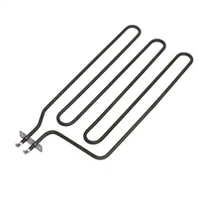
Picture a heavyweight lifter: strong, resilient, and protected against the elements. The Tubular Heater encapsulates its coiled wire in a compacted bed of magnesium oxide insulation, all sealed within a metal sheath (often stainless steel or incoloy). Fins are frequently added to its armor. This design philosophy is maximal protection. It prioritizes the absolute safeguarding of the element from a harsh world, accepting some inherent trade-offs in peak thermal agility.

The Duel of Attributes: A Point-by-Point Narrative
On the Battlefield of Efficiency and Response:
Here, the Open Coil design dominates. By exposing the coil, it achieves direct-contact heat transfer. Air molecules collide directly with the high-temperature wire, and radiant energy fires unimpeded into the air stream. The result is exceptional thermal efficiency-often surpassing 90%-and a blisteringly fast response time (seconds). There is no thermal lag.
The Tubular Heater, in contrast, must play a longer game. Heat must conduct through the insulating MgO to the sheath, and only then can it convect to the air. This introduces thermal resistance and mass, lowering efficiency and causing a slow, gradual heat-up and cool-down (minutes). While fins help, they cannot overcome this fundamental physics.
On the Question of Power and Space:
Need a lot of heat in a small space? The Open Coil Heater is your solution. Its ability to operate at very high surface watt densities allows it to deliver intense power from a compact footprint. The Tubular Heater is constrained by the need to prevent its internal insulation from overheating, capping its power density.
Concerning the Flow of Air:
The lean Open Coil structure presents minimal obstruction to airflow, resulting in a low pressure drop. This allows for smaller, more efficient fans and lower system energy consumption. The finned sheath of a tubular heater, while increasing surface area, acts like a dense radiator in a duct, significantly impeding airflow and demanding more fan horsepower.
In the Arena of Environment and Durability:
This is where the narrative flips. The Tubular Sheathed Heater is the undisputed champion of harsh environments. Its sealed sheath is a fortress against moisture, corrosive fumes, conductive dust, and physical contact. It is the default, robust choice for dirty, wet, or unpredictable industrial settings.
The exposed coil of its counterpart is inherently vulnerable. In a clean, dry air stream, it will outlast many tubular heaters. But introduce moisture, chemical vapors, or flying debris, and it becomes susceptible to corrosion, short circuits, and degradation. Its performance excellence comes with a requirement for a controlled environment (or significant protective engineering).
Regarding Flexibility and Control:
For complex applications, the Open Coil Heater offers unparalleled design freedom. Coil spacing, wire gauge, and alloy can be varied along its length to create custom heat profiles, matching uneven airflow or specific thermal zones. Its fast response makes it a perfect partner for precise PID control systems.
Tubular heaters offer less internal customization. While they can be bent into shapes, the heat output along their length is generally uniform. Their slow thermal response makes them less suited for dynamic processes requiring rapid temperature adjustments.
Conclusion: Your Application Writes the Script
At JAYE-HEATER, we serve as your engineering consultants in this critical decision. There is no universal winner, only the optimal component for your system's unique story.
Bring us your parameters: your air flow, your temperature profile, your environmental contaminants, your spatial limits, and your control needs. We will analyze the narrative of your application and recommend the thermal technology-or a custom-engineered hybrid of principles-that delivers the ideal balance of performance, longevity, and total cost of ownership.
Let's write the most efficient story for your project together.