The primary role of PI film heaters in drones is active thermal management, ensuring critical components operate reliably in cold or harsh environmental conditions, thereby expanding the drone's operational envelope.


1. Key Functions & Applications
a. Battery Heating & Thermal Regulation
Problem: Lithium-polymer (LiPo) batteries suffer severe performance degradation in low temperatures (below 0°C/32°F), including reduced capacity, voltage sag, and inability to deliver high current, leading to dramatically shortened flight time or sudden power failure.
Solution: Thin, flexible PI heaters are attached to battery packs. They pre-heat the batteries before takeoff or provide in-flight warmth, maintaining an optimal operating temperature range (typically 5–20°C / 41–68°F). This ensures consistent power delivery and maximizes flight endurance in cold weather.
b. Optical Sensor & Camera De-fogging/De-icing
Problem: Lenses on gimbal cameras, LiDAR, or thermal imaging sensors can fog up or frost over due to condensation when moving between different temperature/humidity zones, critically impairing data acquisition and image quality.
Solution: Transparent or annular (ring-shaped) PI heaters are integrated around the lens housing. By keeping the lens surface temperature above the dew point, they prevent condensation and ice formation, ensuring clear visibility at all times.
c. Avionics & Flight Controller Temperature Stabilization
Problem: Sensitive electronic components like the flight controller, IMU (Inertial Measurement Unit), barometer, and GPS modules can experience data drift, latency, or malfunction in extreme cold.
Solution: Small, precision PI heaters are mounted underneath critical PCBs or specific chips. They provide localized heating to maintain these components within their specified temperature range, enhancing overall system stability and data accuracy.
d. Propeller & Airframe Anti-icing
Problem: During flights in moist, sub-freezing conditions (e.g., in clouds or freezing rain), ice can accrete on propeller blades and leading edges of wings (on fixed-wing drones). This alters aerodynamics, increases weight, and can lead to a catastrophic loss of lift and control.
Solution: Flexible PI heating films are applied to vulnerable surfaces. They provide cyclic or constant heating to prevent ice formation or melt existing ice, a critical feature for larger commercial and industrial drones operating in challenging climates.
e. Payload Compartment Heating
Problem: Specialized scientific or sampling payloads (e.g., certain gas sensors, fluid collection systems) may require a controlled ambient temperature to function correctly.
Solution: PI heaters line the payload bay, creating a stable microclimate for sensitive equipment carried by the drone.
2. Why PI (Polyimide) Film is the Preferred Choice?
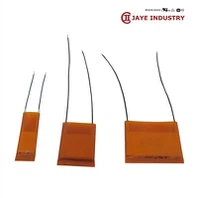
Ultra-Thin & Flexible: Typically less than 0.2mm thick, they conform perfectly to curved and irregular surfaces (like batteries or lenses) without adding significant weight or affecting aerodynamics.
Fast Thermal Response: Low thermal mass allows for rapid heat-up times (seconds to a few minutes) and precise control.
Exceptional Temperature Range: Can operate continuously from -269°C to +250°C (with short-term peaks up to 400°C), making them ideal for aerospace extremes.
Excellent Dielectric Strength: Polyimide is a superb electrical insulator, preventing short circuits even when in direct contact with electronic components.
Chemical & Environmental Resistance: Highly resistant to moisture, chemicals, and corrosion, ensuring long-term reliability.
Reliability & Safety: Their etched-foil or printed elements offer uniform heating and are highly durable against vibration-a key requirement for drones.
3. Implementation & Design Considerations
Power Management: Heating power draw must be carefully calculated and integrated into the drone's overall power budget to avoid excessively draining the flight battery.
Control System: Requires integration with temperature sensors (thermocouples/RTDs) and a PID (Proportional-Integral-Derivative) controller to achieve precise, closed-loop temperature regulation, avoiding energy waste or overheating.
Integration Method: Typically bonded using high-temperature adhesives (e.g., silicone, acrylic) or designed as modular inserts. Mechanical placement must not interfere with other components or functions.
Durability: Must withstand the vibrations and G-forces experienced during drone flight.
PI polyimide film heaters are a critical enabling technology for drones that need to operate reliably beyond fair-weather conditions. By providing lightweight, efficient, and targeted heat to batteries, sensors, and electronics, they directly combat the challenges posed by low-temperature environments.
This translates to:
Extended operational seasons and geography.
Guaranteed performance and data quality.
Enhanced safety and system reliability.
Protection of valuable payloads and the drone itself.
They are a hallmark feature of robust, professional, and industrial-grade drones designed for missions in surveying, inspection, delivery, defense, and polar/altitude research.

One-stop Heating & Controllers Factory in China
Upgrade your heating systems with Jaye Heater's premium components. For reliable heating elements and precise thermal controllers that ensure performance and safety, contact our experts today for a quote and technical support. Let's find your perfect heating solution.