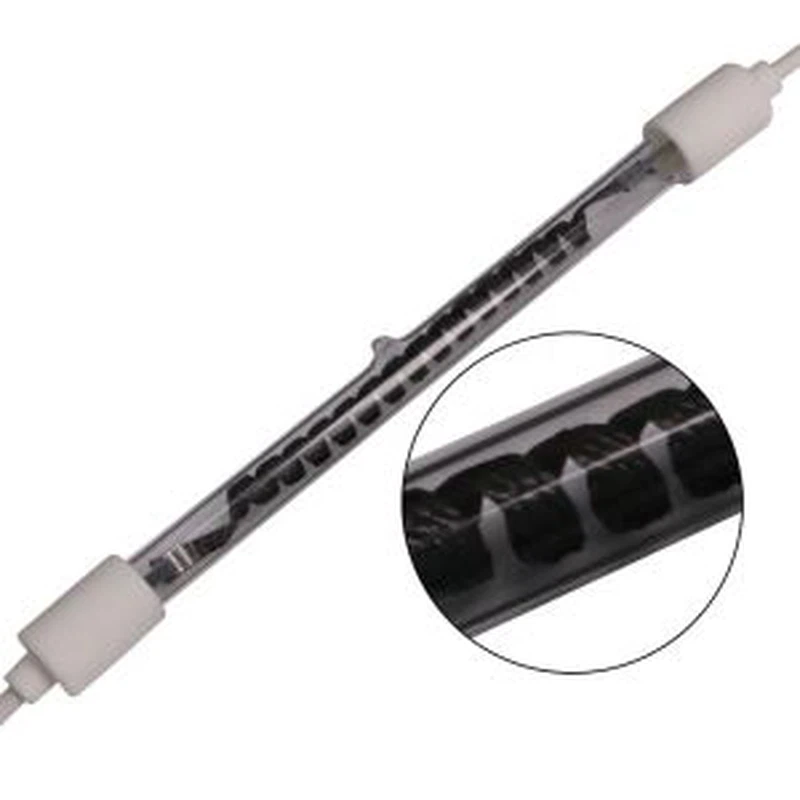
Carbon fiber quartz heating lamps are highly efficient infrared (IR) heaters commonly used for drying applications in industries such as automotive, textiles, and coatings. They work based on the principle of infrared radiation, which transfers heat directly to objects without heating the surrounding air. Here's how they function in drying processes:
Working Mechanism
Infrared Radiation Emission
The carbon fiber filament inside the quartz tube heats up when an electric current passes through it. This generates infrared radiation, which has wavelengths typically in the short-wave (near IR) or medium-wave (mid IR) range, depending on the lamp design.
Efficient Heat Transfer
Unlike conventional convection drying methods that rely on air circulation, IR radiation penetrates directly into the material's surface, accelerating moisture evaporation without excessive energy loss.
Uniform Drying
Carbon fiber quartz heating lamps provide consistent and uniform heat distribution, reducing the risk of overheating or uneven drying that can occur with traditional heating elements.
Rapid Response Time
These lamps heat up and cool down quickly, allowing precise control over the drying process. This is particularly beneficial for industries requiring fast drying times, such as automotive paint curing or textile processing.

Advantages for Drying Applications
Energy Efficiency: Infrared radiation minimizes heat loss, reducing energy consumption.
Non-Contact Heating: Ideal for delicate materials where direct contact heating could cause damage.
High Durability: Carbon fiber filaments offer long service life and resist breakage better than tungsten filaments.
Customizable Wavelengths: Tailored IR wavelengths optimize drying for different materials.