How JAYE's Custom Transparent Heating Films Ensure Crystal-Clear Aerial Footage in Any Environment
In the high-stakes world of commercial and industrial drones, every pixel counts. Whether it's for precision mapping, critical infrastructure inspection, cinematic storytelling, or public safety operations, the data captured from the sky is invaluable. There's nothing more frustrating-or professionally damaging-than reviewing crucial aerial footage only to find it rendered useless by a mysterious, pervasive haze. Drone camera fogging is a silent enemy that plagues pilots across industries, leading to costly rescues, inaccurate data, and missed opportunities. At JAYE, we specialize in engineering the definitive solution: high-performance, fully customizable Kapton heating films that proactively guarantee a clear view, ensuring your mission's success no matter the atmospheric challenges.
1. The Invisible Enemy: A Deep Dive into Drone Camera Fogging
To effectively combat fogging, one must first understand its fundamental cause: condensation. This occurs when invisible water vapor in the air condenses into tiny liquid droplets upon contacting a surface colder than the surrounding air's dew point. For a drone, this scenario is almost a daily routine. A drone may take off from a warm, humid ground-level environment and within minutes, ascend into cooler, high-altitude air. The camera lens and gimbal assembly, often made of glass or metal, have significant thermal mass and can remain cold long after the ambient air has warmed. This temperature differential turns the camera's most critical component-the lens or its protective dome-into the perfect canvas for condensation, blurring the image entirely. This isn't a sign of a faulty product; it's a simple, unforgiving law of physics.
2. Mission-Critical Clarity: Why Image Sharpness is Non-Negotiable for Modern Drones
For autonomous and remotely piloted drones, vision is not just a function; it is the very foundation of their operation. A single blurred or obscured image can have cascading consequences far beyond a simple visual flaw.
Precision Agriculture & Surveying: In photogrammetry and LiDAR-assisted mapping, a fogged lens can create gaps in data, leading to inaccurate terrain models, flawed volume calculations, and incorrect crop health analysis. The cost of re-flying a large survey site is immense.
Infrastructure Inspection: When inspecting a wind turbine blade, a solar farm, or a high-voltage power line, clarity is safety. A fog-induced blind spot could mean missing a critical hairline crack or a worn component, potentially leading to catastrophic failures and enormous financial losses.
Cinematography & Search and Rescue: In these fields, the perfect shot or the critical clue cannot be recreated. A fogged camera in a search-and-rescue mission isn't just an inconvenience; it's a matter of life and death. The operational value of a drone is directly tied to the reliability and sharpness of its visual output.
3. Beyond the Seal: The Surprising Causes of Condensation in "Sealed" Drone Gimbals
A common misconception is that a well-sealed gimbal is inherently fog-proof. Engineering teams go to great lengths to protect sensitive camera electronics from the elements with gaskets and seals. Unfortunately, this is often not enough. Seals can degrade over time due to UV exposure, temperature cycling, and mechanical stress, allowing moist air to slowly infiltrate. More insidiously, the air trapped inside the gimbal during assembly contains moisture. As the drone undergoes rapid temperature fluctuations during flight, this internal moisture condenses on the coldest available surface-the interior of the lens. This "internal fogging" is particularly problematic because it cannot be wiped away and is immune to external environmental controls.
4. Why Traditional Anti-Fog Solutions Fall Short in Aviation Applications
Many have tried to solve this issue with passive methods, but they consistently fall short in the demanding field of aviation.
Chemical Sprays and Wipes: These solutions are temporary. Their effectiveness diminishes after a short period, and they often leave behind micro-residues that can smear or distort images, trading one problem for another.
Desiccant Pouches: While somewhat effective for storage, desiccants like silica gel have a finite moisture absorption capacity. During a long flight in humid conditions, they can quickly become saturated and ineffective, offering no protection for the duration of a mission.
These passive solutions cannot adapt to changing conditions. They are a gamble, not a guarantee. What is required is an active, reliable, and intelligent solution that works consistently from the moment of takeoff to the final second of landing.
5. The Science of a Clear View: How Kapton Heating Films Actively Prevent Fog
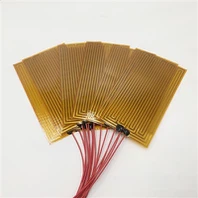
The most effective and reliable method to defeat fogging is to eliminate its root cause: the cold surface. This is where the elegant engineering of JAYE's Transparent Kapton Heating Films comes into play. Our solution involves applying an ultra-thin, flexible, and transparent heating film directly to the camera housing or the lens itself. When activated, the film applies a low, consistent, and uniformly distributed amount of heat across the entire optical surface. This raises the temperature of the glass or lens above the ambient dew point, preventing moisture from condensing. It's a proactive approach-it doesn't clear fog after it forms; it stops it from ever forming in the first place. This ensures a perfectly clear visual path throughout the entire flight envelope, regardless of altitude or weather changes.
6. Beyond De-Fogging: The Strategic Advantages of Integrating Kapton Heaters
Choosing to integrate a JAYE Kapton heater into your drone system delivers a portfolio of strategic advantages that elevate your product's reliability and performance.
Proactive Prevention: As stated, it stops fog before it starts, ensuring mission-ready clarity at all times.
Minimal Impact on Design: Our heaters are incredibly lightweight (often adding less than 10 grams) and ultra-thin (<0.2mm), ensuring no impact on the drone's flight dynamics, balance, or payload capacity.
High Electrical and Thermal Efficiency: They provide rapid thermal response, reaching the target temperature in seconds, all while drawing minimal power from your drone's battery. This careful power management is crucial for maximizing flight time.
Exceptional Durability and Stability: Constructed from polyimide (Kapton) and etched foil elements, our heaters are built to withstand the harsh realities of UAV flight, including constant vibration, shock, and extreme temperature cycling from -200°C to +200°C without performance degradation.

7. Engineered for the Skies: The Key Specifications of JAYE's Aviation-Grade Heating Films
At JAYE, we understand that off-the-shelf solutions rarely fit the precise needs of advanced drone systems. That's why we specialize in OEM and customizing services. Our UAV-grade Kapton heating films are engineered to meet the most demanding specifications:
Superior Optical Clarity: With light transmission rates typically exceeding 90%, our films have a negligible impact on image quality, ensuring your camera's sensor receives all the visual data it needs.
Extreme Thinness and Flexibility: With a profile often less than 0.2mm, our heaters can conform perfectly to curved lenses and complex aerodynamic surfaces without de-lamination or creating air gaps.
Robust Operational Envelope: They perform flawlessly in temperature ranges from -200°C to +200°C, making them suitable for everything from Arctic exploration to high-temperature environments.
Rapid Thermal Response: The low thermal mass allows the heating element to reach its operational temperature in a matter of seconds, providing immediate protection upon activation.
Fully Customizable: This is our core expertise. We tailor the shape, size, voltage (e.g., 5V, 12V, 24V to match your power system), wattage density, and connector type to integrate seamlessly into your specific gimbal and drone architecture.
8. A Practical Guide: Integrating Heating Films into Your Drone Camera System
We design our heaters with integration in mind. The process can be straightforward and adaptable to your manufacturing workflow.
For Retrofit or Prototyping: Our films can be supplied with a high-performance, pressure-sensitive adhesive (PSA) backing. This allows for a simple, clean-room-style application, where the protective liner is removed, and the heater is precisely aligned and bonded to the lens or glass dome.
For OEM Mass Production: For permanent integration into your production line, we can engineer the heater to be a direct part of your assembly process. We provide detailed integration guides, including specifications for power controllers and thermostats, to ensure seamless and reliable performance within your broader electronic system. Our technical support team is available to assist with every step.
9. Partner in Precision: How JAYE Electronics Elevates Your Drone Performance
As a leading manufacturer specializing in advanced thermal solutions, JAYE positions itself as more than just a component supplier-we are your dedicated engineering and development partner. We recognize that every drone model has a unique set of thermal, spatial, and power constraints. Our comprehensive OEM and customization service is designed to meet this challenge head-on. We collaborate directly with your R&D and engineering teams to:
Co-Design a Solution: We develop a heater that matches your exact form factor, optical requirements, and thermal performance goals.
Optimize for Your Platform: We fine-tune power consumption and control logic to work in harmony with your specific battery and power management system.
Ensure Seamless Integration: We deliver a solution that not only works but is also easy to assemble, ensuring manufacturing efficiency and long-term field reliability that reflects the high quality of your brand.
10. Clearing the Air: Your Top Questions on Drone De-Fogging, Answered
Q1: Won't the heater create thermal waves or distortions that ruin the image quality?
A: No. This is a critical concern we've engineered out. Our heaters provide exceptionally uniform heat distribution across the entire surface. By eliminating hot spots and ensuring the entire lens is heated evenly, we prevent the thermal gradients that cause image distortion. The high clarity of the polyimide substrate ensures maximum light transmission.
Q2: My drone has limited battery capacity. How much power will this heater consume?
A: Our heaters are designed for high efficiency. Typical power consumption for a standard lens is in the range of 2 to 8 watts, depending on size and environmental requirements. This is a negligible draw on your drone's battery system, especially when weighed against the guaranteed value of obtaining perfect, usable data and footage for your entire mission. The cost of a lost mission due to fog is always far greater than the minimal power used for prevention.
Q3: My drone's camera has a highly curved lens. Can you really make a heater that fits?
A: Absolutely. The inherent flexibility of our Kapton-based heating films is one of their key advantages. We can precisely die-cut them into complex shapes and curves, ensuring perfect conformity to a wide range of gimbal designs and lens geometries without compromising performance or creating bulk.
Q4: We have a specific certification or reliability standard we need to meet. Can you help?
A: Yes. We regularly work with clients to meet specific industry standards for reliability, materials, and performance. We can provide test data and documentation to support your certification processes. Discuss your requirements with our engineers, and we will endeavor to meet them.
Q5: How do we start the process of developing a custom solution for our new drone model?
A: It's simple. Contact JAYE today! Start by sharing your lens/gimbal CAD drawings, your available power supply specifications (voltage, max current), and your operational performance goals (desired temperature, time to activation). Our engineering team will promptly analyze your needs and develop a prototype solution tailored specifically for you. We are here to turn your fogging challenges into a definitive competitive advantage.
Ready to eliminate fogging for good and deliver unparalleled reliability to your customers? Contact the heating experts at JAYE today to discuss your OEM and customization needs. Let's partner to give your drones the clear, reliable vision they deserve, from takeoff to landing.
Click here to know more about our Kapton Heater