If you design battery packs for electric vehicles, commercial vehicles, or stationary energy storage, you already know that battery performance is not just a cell chemistry problem. It is a thermal problem. Lithium-ion cells deliver rated capacity and accept charge within a limited temperature window. Below that window, internal resistance rises, available capacity drops, and charging must be restricted. Charging a cold cell too aggressively can cause lithium plating, which permanently degrades capacity and creates a safety risk.
That is why battery heating is not optional in cold-climate markets. The question is not whether to heat the pack, but how to heat it efficiently, evenly, and without adding unnecessary weight or volume. Flexible heaters have become the default answer for many pack designs because they solve the thermal problem in a way rigid heaters cannot.
Why Battery Packs Need Heating in the First Place
A battery pack is not a uniform thermal mass. Cells near the pack walls lose heat faster than cells in the center. Modules near a cold floor or a metal enclosure run cooler than modules surrounded by other modules. Without active thermal management, those differences persist and grow.
The consequences show up in several ways. Cold cells have higher internal resistance, so the pack delivers less voltage under load and generates more heat during discharge. Charging is limited because the cell cannot accept current without risking lithium plating. Available capacity drops, which means reduced range in winter. And if some cells are colder than others, the pack management system has to protect the coldest cell, which derates the entire pack.
Heating the pack solves these problems, but only if the heat is distributed evenly. A localized hot spot is worse than no heat at all-it creates temperature gradients across the pack, accelerates aging in the warmer cells, and can trigger thermal runaway if the heater is not properly controlled.
Why Flexible Heaters Fit Battery Pack Architecture
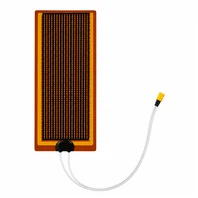
Flexible heaters-typically silicone rubber heaters or polyimide film heaters-are thin, conformable, and available in custom shapes. Those three characteristics map directly onto the constraints of battery pack design.
How Flexible Heaters Conform to Cell and Module Geometry
Battery packs are not flat. They contain cylindrical cells, prismatic cells, pouch cells, cooling plates, busbars, and structural members. A rigid heater can only make contact where the geometry allows. A flexible heater can be bonded or clamped directly against the surface that needs heat-the bottom of a module, the side of a cell holder, or the face of a cooling plate.
That intimate contact matters. Heat transfer from a heater to a cell is dominated by conduction. Any air gap between the heater and the cell acts as a thermal resistance. A flexible heater that conforms to the surface eliminates that gap and delivers heat where it is needed, not into the air inside the enclosure.
How Flexible Heaters Provide Uniform Heat Distribution
A well-designed flexible heater uses a resistance element-wire-wound or etched foil-distributed across the entire heater area. That distribution allows the heater to deliver relatively uniform watt density over the surface it covers. When the heater is bonded to a module base or a cell holder, the heat spreads laterally through the heater and the adjacent structure, reducing the temperature differences between cells.
This is the opposite of a point-source heater. A cartridge or a small rigid heater creates a hot spot that has to spread by conduction through the pack. A flexible heater covers the area, so the heat starts out distributed.
How Flexible Heaters Reduce Weight and Volume
Battery packs are weight- and volume-sensitive. Every component has to justify its mass and its packaging space. Flexible heaters are thin-often only a fraction of a millimeter to a few millimeters thick-and lightweight. They can be laminated directly to a surface or inserted between existing components without requiring a separate mounting bracket or a large air gap.
That thin profile also means low thermal mass. A flexible heater heats up quickly and responds fast to control input, which helps the battery management system bring the pack to temperature without overshooting.
How Flexible Heaters Support Integration and Safety
Battery heating is not just a thermal function. It is part of the pack's electrical and safety architecture.
Flexible heaters are electrically insulated by construction-the resistance element is encapsulated between layers of silicone or polyimide. That insulation provides dielectric strength against the pack voltage and protects the element from moisture, condensation, and electrolyte exposure. Silicone rubber heaters are particularly suited to battery applications because silicone remains flexible over a wide temperature range and resists aging.
Flexible heaters can also be supplied with integrated temperature sensors-thermocouples, RTDs, or thermistors-and thermal fuses. That integration lets the battery management system monitor the heater surface directly and interrupt power if the temperature exceeds a safe limit. A separate sensor mounted elsewhere in the pack cannot provide the same level of protection.
From a manufacturing standpoint, flexible heaters with pressure-sensitive adhesive backing or mechanical fastening tabs can be installed in the pack assembly line without complex tooling. That reduces assembly time and eliminates the risk of a rigid heater cracking during installation or vibration.
What to Specify and Verify When Sourcing Battery Heaters
If you are specifying flexible heaters for a battery pack, here are the parameters that determine whether the heater will perform in the field.
Power density and voltage. Match the heater wattage to the pack's thermal load and the available system voltage. Too much power density creates hot spots; too little extends heat-up time.
Heater area and placement. The heater should cover the area that needs heat, not just a convenient mounting location. Confirm the heat distribution across the module and the expected temperature gradient.
Insulation and dielectric strength. Confirm the heater's insulation system is rated for the pack voltage and the expected environmental conditions.
Sensor and fuse integration. If the battery management system needs direct heater feedback, specify integrated sensors and thermal protection devices.
Adhesive and mounting method. The bond between the heater and the cell or module surface determines conduction efficiency. Confirm the adhesive system, surface preparation, and cure requirements.
Temperature range and cycling. Battery packs see repeated thermal cycles. Confirm the heater's rated operating temperature and cycle life against the pack's duty profile.
FAQ: Common Questions About Flexible Battery Heaters
How does a flexible heater avoid overheating the battery?
The heater itself is designed for a specific watt density, and it can be paired with integrated temperature sensors and thermal fuses. The battery management system controls power to the heater and interrupts it if the temperature exceeds the safe limit.
Can flexible heaters be used in high-voltage battery packs?
Yes, provided the heater's insulation system is rated for the pack voltage and the application's dielectric requirements. Silicone and polyimide insulation systems are available in configurations suitable for high-voltage packs.
If you are designing a battery pack and need a heating solution that fits your architecture, send us your pack dimensions, target temperature range, system voltage, and thermal load. Our engineering team at Jaye Heater will recommend the right flexible heater configuration-silicone or polyimide, with or without integrated sensors and thermal protection-provide samples for your thermal testing, and quote production pricing. We have been making flexible heaters for battery and energy storage OEMs for over a decade.