The electroplating industry faces unique challenges in maintaining precise temperature control, corrosion resistance, and operational efficiency. Flange-type immersion heaters have emerged as the preferred solution for over 90% of electroplating facilities globally. Below is a detailed analysis of the technical and economic drivers behind this trend:
**1. Corrosive Environments Demand Robust Material Science
Industry Challenge:
Electroplating baths contain highly aggressive chemicals (e.g., sulfuric acid, chromic acid, cyanide solutions). Traditional heating elements (e.g., tubular heaters) corrode rapidly, leading to frequent replacements and production downtime.
Why Flange Heaters Dominate:
Material Superiority:
Titanium (Gr.7/12): Ideal for acidic baths (pH <3), offering 10x longer lifespan than stainless steel.
Tantalum or PTFE-Coated Elements: Used in fluoride-rich or alkaline solutions to prevent pitting corrosion.
Sealed Flange Design: Prevents acid ingress into electrical components, reducing short-circuit risks.

**2. Precision Temperature Control for Consistent Plating Quality
Industry Challenge:
Electroplating requires strict bath temperature ranges (e.g., 45–60°C ±1°C). Temperature fluctuations cause defects like poor adhesion or uneven coating thickness.
Flange Heater Advantages:
Direct Immersion Heating:
Eliminates heat loss from external circulation systems, achieving 98% thermal efficiency.
Rapid response: Adjusts bath temperature within 2–5 minutes vs. 15+ minutes for external heat exchangers.
Integrated PID Controllers:
Maintain ±0.3°C accuracy via real-time feedback from submerged RTD sensors.

**3. High-Density Power Design for Faster Production Cycles
Industry Challenge:
Electroplating lines often require rapid heating of large-volume baths (e.g., 10,000+ liters) to meet tight production schedules.
Technical Edge of Flange Heaters:
Power Density Optimization:
Customizable watt densities (5–30 W/cm²) to balance heating speed and material stress.
Example: A 50 kW titanium flange heater can raise a 5,000L nickel bath from 20°C to 50°C in 90 minutes.
Modular Scalability:
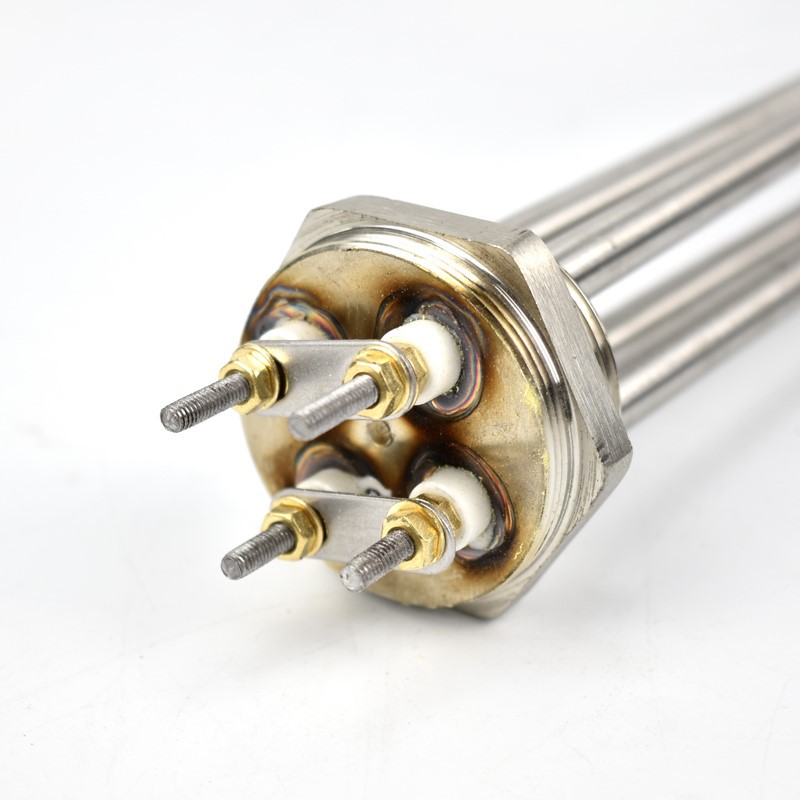
Multiple flange units can be installed in parallel to meet surge demands without redesigning the tank.
**4. Reduced Maintenance Costs & Downtime
Industry Challenge:
Frequent heater failures disrupt production and increase labor costs for cleaning/descaling.
Flange Heater Solutions:
Easy Maintenance Access:
Flange-mounted heaters can be removed without draining the tank, cutting maintenance time by 70%.
Anti-Scaling Technology:
Electropolished surfaces or ultrasonic descaling ports minimize scale buildup in hard water regions.

**5. Compliance with Global Safety Standards
Industry Challenge:
Electroplating facilities face stringent regulations (e.g., OSHA, REACH) for worker safety and hazardous material handling.
Certifications & Safety Features:
Explosion-Proof Designs: ATEX/IECEx-certified heaters for hydrogen-rich environments (common in zinc or cadmium plating).
Leakage Current Protection: <30 mA detection to prevent electrolytic bath contamination.

**6. ROI Case Study: Cost Savings in a Chromium Plating Plant
Scenario:
A mid-sized plant switched from quartz sleeve heaters to titanium flange heaters.
Results (12-Month Period):
Energy Savings: 32% reduction in kWh usage due to direct heating.
Maintenance Costs: Dropped from 2,500/year.
Production Uptime: Increased from 82% to 96%.

Conclusion: The Electroplating Industry's Heating Paradigm Shift
Flange-type immersion heaters dominate electroplating because they solve critical pain points:
Material Science: Survival in extreme corrosion.
Precision: Micron-level plating quality control.
Economics: Faster ROI than traditional methods.