Silicone rubber heaters are flexible electric heating elements used to heat or maintain the temperature of metal plates, pipes, tanks, battery components, and other equipment. Choosing the right heater involves more than specifying voltage and wattage.
The heater's dimensions, watt density, operating environment, mounting method, and temperature control requirements all affect its performance.
For a custom silicone rubber heater, start with the temperature you need to maintain, the material and shape of the heated part, and the available installation space. Then confirm the electrical specifications and mounting method.
This guide explains seven key factors to consider before requesting a quotation.

1. Define the Required Temperature and Operating Environment
Before selecting a silicone rubber heater, distinguish between the heater's maximum allowable operating temperature and the temperature you need the heated object to reach.
These are not the same. The required heater design depends on the temperature of the heated surface, ambient conditions, heat loss, and how the equipment operates.
Consider the following questions:
What is the target temperature of the heated object?
What is the minimum and maximum ambient temperature?
How quickly must the object reach the target temperature?
Will the heater operate continuously or intermittently?
Is the heater exposed to moisture, chemicals, vibration, or outdoor conditions?
Silicone rubber heaters are used in many low- and medium-temperature heating applications, but the allowable temperature varies by heater construction, materials, and mounting method. Confirm the rated limits for the specific design rather than assuming that every silicone heater has the same temperature range.
For applications requiring high temperatures or extended continuous operation, the heater construction, watt density, insulation, and temperature control should be reviewed together.
2. Choose the Right Shape, Size, and Heating Area

Silicone rubber heaters can be manufactured in different shapes and dimensions to fit the surface being heated. Common designs include rectangular pads, circular heaters, strips, and custom-cut shapes with holes or cutouts.
The available heating area affects how heat is distributed across the target surface. A heater that is too small may create localized hot spots, while a poorly positioned heater may leave parts of the surface cooler than required.
When defining the dimensions, consider:
- Overall length and width, or diameter for a round heater
- Available installation space and required clearances
- Mounting holes, slots, cutouts, or irregular contours
- The shape and dimensions of the mating surface
- Lead-wire exit position and cable routing
- Required flexibility and minimum bending radius
A flexible heater should fit the intended surface without being stretched, sharply folded, or forced into a shape outside its design limits.
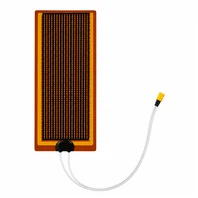
For flat metal components requiring close surface contact, a custom silicone rubber heating pad may be suitable. For a narrow or elongated heating area, a silicone rubber heating strip may be more appropriate.
3. Determine the Required Wattage and Watt Density
Wattage determines the electrical power supplied to the heater, while watt density describes the power applied per unit of active heating area.
The basic relationship is:
Watt density = Heater wattage ÷ Active heating area
For example, a 100 W heater with an active heating area of 100 cm² has a nominal watt density of 1 W/cm².
This calculation is only a starting point. It does not prove that the heater will reach a particular temperature or heat the target uniformly.
The required wattage depends on factors such as:
- Mass and specific heat capacity of the heated object
- Required temperature rise and heating time
- Heat loss to the surrounding air and mounting structure
- Thermal conductivity of the heated material
- Insulation and installation conditions
- Whether the heater maintains temperature or heats up from cold
Watt density also needs to be evaluated against the heater construction and mounting method.
A heater bonded to a metal surface may behave differently from one wrapped around a curved object or operating with limited heat dissipation.
Do not select wattage based only on the size of the heater or the maximum temperature stated in a general product description. If the heating load is uncertain, provide the application conditions so the design can be reviewed.
4. Confirm Voltage, Wattage, and Electrical Requirements
Voltage and wattage must match the available power supply and the equipment's electrical design.
Common specification details include:
- Rated voltage, such as 12 V, 24 V, 120 V, or 230 V
- Required wattage
- AC or DC power supply
- Resistance and acceptable tolerance, where specified
- Lead-wire type, insulation, length, and exit direction
- Insulation resistance and dielectric-strength requirements
- Applicable product or component certifications
Voltage and wattage are related to electrical resistance. For a resistive heater operating at its rated conditions:
Power (W) = Voltage² ÷ Resistance (Ω)
The final resistance and heater circuit must be designed for the specified electrical conditions.
For equipment used in regulated industries or exported to specific markets, confirm any applicable certification and documentation requirements before finalizing the design.
Certification should be verified for the specific product or configuration; it should not be assumed to apply to every custom heater.
5. Select the Heating Element Construction
Silicone rubber heaters commonly use resistance-wire or etched-foil heating elements. The appropriate construction depends on the required heating pattern, dimensions, power distribution, and available installation space.
| Consideration | Resistance-wire heater | Etched-foil heater |
|---|---|---|
| Heating element | Resistance wire arranged in a circuit pattern | Thin metal foil patterned into a circuit |
| Design flexibility | Suitable for many flexible heater designs | Suitable for custom circuit patterns and shaped heating areas |
| Heating distribution | Depends on wire layout and spacing | Can be tailored through the foil circuit pattern |
| Design considerations | Wire routing, spacing, and local heat concentration | Foil pattern, resistance, active area, and heat distribution |
| Final selection | Depends on the specific application | Depends on the specific application |
Neither construction is automatically better for every application.
The choice should be based on the required heating performance, dimensions, wattage, production requirements, and cost.
Learn more about resistance-wire silicone heaters and etched-foil silicone heaters.
6. Choose the Mounting Method and Temperature Control
Mounting affects heat transfer, installation stability, and the heater's operating conditions. It should be considered during the design stage rather than after the heater has been manufactured.
Common mounting methods include:
- Pressure-sensitive adhesive (PSA): Useful for suitable clean, smooth surfaces where a convenient adhesive-backed installation is required.
- Mechanical fastening: Straps, clips, or other suitable fasteners can be used for certain removable or curved-surface installations.
- Bonding or vulcanization: May be considered when a more permanent attachment is required and the materials and process are compatible.
The correct method depends on the surface material, geometry, operating temperature, watt density, and whether the heater needs to be removed for maintenance.
During installation, avoid trapped air, uneven contact, wrinkles, and damage to the heater.
Poor contact can reduce heat transfer and create localized overheating. Adhesive temperature limits must also be checked separately from the silicone heater's own temperature rating.
Do you need a thermostat or temperature sensor?
Temperature control should be evaluated according to the application's requirements.
A thermostat, thermocouple, RTD such as a Pt100, or another compatible sensor may be used in an appropriate design.
The choice depends on the required temperature range, control accuracy, sensor location, response time, and control system.
A temperature sensor does not automatically provide independent over-temperature protection. If the application requires a separate safety cutout, define that requirement explicitly and verify the complete protection arrangement.
Do not assume that a conventional silicone rubber resistance heater is self-regulating. Its temperature must be managed according to the heater design and application conditions.
7. Check Environmental Conditions, Safety, and Service Requirements
The heater must be suitable for its actual working environment, not just its nominal electrical specifications.
Review the following before ordering:
- Moisture exposure: Confirm the protection level of the complete heater assembly. Silicone rubber construction alone does not guarantee suitability for immersion or every wet environment.
- Chemical exposure: Check compatibility with the actual chemicals, cleaning agents, oils, or other substances present.
- Mechanical conditions: Consider vibration, abrasion, repeated bending, and the possibility of damage during installation or maintenance.
- Thermal cycling: Confirm whether the heater will experience frequent start-stop cycles or long periods at elevated temperatures.
- Electrical safety: Verify the insulation, grounding or protective measures where applicable, and the required electrical tests.
- Serviceability: Determine whether the heater must be removable, replaceable, or accessible for inspection.
For critical equipment, testing the heater in the actual mounting arrangement is valuable because contact conditions and heat loss can differ significantly from those in an isolated bench test.
Silicone Rubber Heater Selection Checklist
Use this checklist to organize the information needed for a design review or quotation.
| Specification | Information to prepare |
|---|---|
| Application | What equipment or component will be heated? |
| Heated object | Material, shape, and dimensions |
| Heater shape | Strip, rectangular pad, round heater, or custom shape |
| Heater dimensions | Length, width, diameter, thickness, and cutouts |
| Power supply | Rated voltage and AC/DC |
| Power requirement | Required wattage, if known |
| Mounting | Adhesive, mechanical fastening, bonding, or another method |
| Temperature control | Thermostat, sensor, external controller, or separate safety cutout requirements |
| Leads | Wire type, length, exit direction, and connector requirements |
If some values are unknown, provide the available drawing, photos, and application details first. The missing specifications can then be identified for further review.
Frequently Asked Questions
1. Can a silicone rubber heater be customized to fit my equipment?
Many silicone rubber heaters can be customized in shape, dimensions, voltage, wattage, lead configuration, and mounting options, depending on the design and manufacturing requirements. A drawing or dimensioned sketch is the best starting point for checking feasibility.
2. How do I calculate the wattage required for a silicone rubber heater?
Start with the mass of the heated object, its material properties, the required temperature rise, and the desired heating time. Then account for heat losses and installation conditions. Watt density should also be checked against the heater construction and mounting method. A simple wattage calculation is an estimate, not a guarantee of actual heating performance.
3. Can a silicone rubber heater operate without a temperature controller?
That depends on the heater design, watt density, heat dissipation, load, and operating conditions. Do not assume that an ordinary resistance-wire or etched-foil silicone heater will regulate its own temperature. The need for temperature control and independent over-temperature protection should be evaluated for the application.
4. Is an adhesive-backed silicone heater suitable for every surface?
No. Adhesive selection depends on surface cleanliness, surface material, geometry, temperature, and operating conditions. The adhesive may have a lower allowable temperature than the heater itself. Uneven surfaces and trapped air can also affect heat transfer and service life.
5. Are silicone rubber heaters waterproof?
Not all silicone rubber heaters have the same moisture protection. The suitability of a heater for splashes, outdoor exposure, washdown, or immersion must be verified for the complete design and its electrical connections. Do not assume that a silicone outer layer makes every heater waterproof.