If you've ever pulled a perfectly baked loaf of sourdough or a Neapolitan pizza out of a deck oven, you know the result: crispy, blistered crust on the bottom, evenly browned top, and an interior crumb that's light and airy. That's not an accident. It's the result of carefully balanced top and bottom heat-and the heating elements that deliver it.
Deck ovens are different from convection ovens. Convection ovens rely on fans to circulate hot air. A deck oven, by contrast, uses radiant heat from both the top and the bottom. The baking surface-typically a thick stone or steel plate-absorbs heat and transfers it directly to the product. This radiant heat, combined with the thermal mass of the deck, creates the ideal environment for bread with crackling crusts, pizzas with charred undersides, and pastries that rise evenly.
The heating elements that make this possible? Finned tubular heaters, arranged in specific configurations at the top and bottom of each baking chamber.
Top Heat: Radiant Heat from Above
The top heating elements in a deck oven are mounted in the ceiling of the baking chamber. Their job is to radiate heat downward, directly onto the top surface of the product.
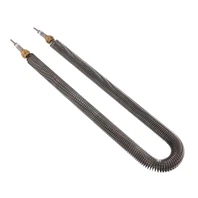
In a typical commercial deck oven, these top elements are arranged in a U-shape configuration, spaced evenly across the ceiling-often every 9.5 inches (about 24 cm). This spacing ensures that radiant heat reaches every part of the baking surface uniformly.
Why finned tubular heaters for top heat?
Finned heaters offer a significant advantage over bare tubular elements in this application. The fins-typically spiral-wound stainless steel, 4 to 5 fins per inch, furnace-brazed to the sheath-dramatically increase the surface area available for heat transfer.
In a deck oven, the top elements operate in an air-filled cavity. Bare tubes would need to run at very high surface temperatures to push enough radiant heat downward. Finned elements, with their extended surface area, can deliver the same heat output at lower sheath temperatures. Lower sheath temperature means:
Less thermal stress on the element
Slower oxidation of the sheath material
Longer element life
More consistent radiant output over time
The top elements also contribute to convection currents within the oven chamber. As the finned elements heat the air, the fins promote airflow circulation, helping to equalize temperature throughout the cavity.
Bottom Heat: Through the Deck
Bottom heat in a deck oven works differently from top heat. The bottom heating elements are mounted beneath the baking surface-under the stone or steel deck. They heat the deck from below, and the deck then radiates heat upward into the product.
This is where the thermal mass of the deck becomes critical. A cordierite stone or thick steel plate-typically 20mm thick or more-absorbs heat from the bottom elements and stores it. When you load cold dough onto the deck, the stone immediately transfers that stored heat to the bottom of the product, creating the rapid "oven spring" that gives bread its volume and pizza its char.
The bottom elements themselves are typically the same U-shaped finned tubular heaters used for top heat, arranged in parallel rows beneath the deck. Some designs use spiral or coiled heating elements embedded within the stone itself, but the finned tubular approach remains the most common for electric deck ovens.
Why finned tubular heaters for bottom heat?
In the confined space beneath the deck, heat transfer efficiency matters. Finned elements allow more wattage to be packed into a limited space. A bare tube might require more elements or a larger cavity to achieve the same heat output. Finned elements achieve it with a more compact footprint.
The fins also help distribute heat more evenly across the underside of the deck. Instead of hot spots directly above each element, the extended fin surface spreads the heat, resulting in more uniform deck temperatures from edge to edge.
Independent Control: Why It Matters
One of the defining features of a commercial deck oven is independent control of top and bottom heat. Each set of elements-top and bottom-has its own thermostatic control. This allows the operator to dial in different temperatures for the top and bottom of the baking chamber.
Why is this important? Different products need different heat balances.
Bread: Needs strong bottom heat for oven spring and a well-developed crust, with moderate top heat to avoid over-browning before the interior is fully baked.
Pizza: Requires intense bottom heat to char the underside, while top heat is adjusted to melt cheese and cook toppings without burning.
Pastry: Delicate items need gentle, even heat from both directions to rise properly without scorching.
Independent control also gives bakers the ability to compensate for variations in dough temperature, humidity, or product load.
What We Tell Deck Oven OEMs
If you're designing a commercial deck oven or upgrading an existing model, here's what we recommend you consider about the heating elements:
Element spacing. The industry standard of every 9.5 inches exists for a reason. It's been proven to deliver uniform heat distribution across the baking surface. Deviate from this without careful thermal modeling, and you'll create cold spots.
Wattage per element. Typical elements range from 1000W to 3500W, depending on deck size and voltage. Total oven power can reach 24kW for a three-deck unit. The right wattage depends on your target temperature range-many deck ovens go up to 500°C (932°F) or higher.
Sheath material. Deck ovens run hot and cycle frequently. For standard applications, stainless steel 304 is common. For higher temperatures or environments with steam injection, consider SS321 or Incoloy 800 for better high-temperature stability and corrosion resistance.
Fin attachment. In a deck oven, the heating elements undergo repeated thermal cycling-from room temperature to 250°C or higher, multiple times a day. Press-fit fins can loosen over time. Furnace-brazed fins stay permanently bonded to the sheath, maintaining heat transfer efficiency through thousands of cycles.
Element shape. Most deck ovens use U-shaped elements for both top and bottom heating. The U-shape allows both electrical terminations to be at the same end, simplifying wiring and reducing the number of cold sections in the heating zone.
Commercial deck ovens rely on a carefully balanced system of top and bottom radiant heat. Finned tubular heaters are the workhorses that deliver that heat-mounted in the ceiling for top heat, mounted beneath the deck for bottom heat. Their extended surface area allows them to run at lower temperatures, last longer, and distribute heat more evenly than bare tubes.
The ability to control top and bottom heat independently gives bakers the flexibility to handle everything from artisan bread to pizza to delicate pastries. And for OEMs, getting the element spacing, wattage, sheath material, and fin attachment right is what separates a reliable oven from one that generates service calls.
If you're manufacturing commercial deck ovens and want to optimize your heating element design, send us your deck dimensions, target temperature range, and voltage requirements. We'll recommend a finned tubular heater configuration-U-shape, wattage, sheath material, and fin density-provide samples for testing, and quote production pricing. We've been making finned heaters for bakery equipment OEMs at Jaye Heater for over a decade.
Click here to request a quote or email us. We'll respond within one business day.