If you design air curtains, you already know the heating element is where the thermal and mechanical trade-offs converge. The housing has a fixed envelope. The fan delivers a specific airflow-typically 6 to 12 m/s at the discharge. The doorway width determines how much heated air you need to push across the opening. Within those constraints, the heating element has to transfer enough watts into the moving airstream without running so hot that it oxidizes, warps, or fails prematurely.
That is the problem finned heating tubes solve. Not by changing the physics of air-side convection, but by changing the area over which that convection acts.
Why Air Curtains Need Extended Surface Heating
Air is a poor heat transfer medium. Its thermal conductivity is a fraction of water's or metal's, and the convective heat transfer coefficient for air flowing over a bare tube is typically in the range of 20–80 W/m²K under forced convection-depending on velocity and geometry. A bare tubular heater in an air curtain therefore has to run at a high sheath temperature to push enough heat into the passing air. High sheath temperature accelerates oxidation of the sheath, stresses the magnesium oxide insulation, and shortens element life.
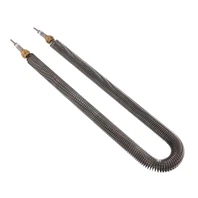
A finned tube changes that balance by adding surface area. Helical fins-usually 4 to 5 fins per inch-are wound onto the tubular sheath and furnace-brazed in place. The finned surface area can be 10 to 15 times that of a bare tube of the same length. Because heat transfer is proportional to surface area, the element can deliver the same heat output at a much lower sheath temperature, or deliver significantly more heat from the same housing envelope.
How Finned Tubes Improve Heat Transfer in Air Curtains
How Fin Surface Area Increases Heat Dissipation
A finned tubular heater can dissipate about 2.5 times more heat than a bare tube of similar dimensions. The allowable surface power load increases 3 to 4 times. In air curtain terms, that means you can achieve the required kW rating with a shorter, more compact element-or pack more heating capacity into the same housing. The fins do not dramatically change the air-side heat transfer coefficient; they increase the area over which that coefficient acts.
Why Lower Sheath Temperature Extends Element Life
For the same wattage in the same airstream, a finned element runs at a lower sheath temperature than a bare tube. Lower sheath temperature means slower oxidation, less thermal stress on the insulation, and more consistent performance over time. In an air curtain that cycles on and off with door traffic, that difference shows up in reduced warranty claims and fewer field replacements.
Why Furnace-Brazed Fins Matter More Than Fin Density Alone
The fin-to-sheath bond determines whether the fins actually transfer heat or just sit there looking useful. Crimped or press-fit fins can loosen under thermal cycling. Once they loosen, contact resistance at the interface defeats the purpose of adding surface area. Furnace-brazed fins create a metallurgical bond-the fin and sheath behave as a single piece of metal. Brazed fins transfer heat at roughly double the efficiency of unbrazed designs, and they stay bonded through thousands of cycles.
How to Compare Bare Tube vs Finned Tube for Air Curtain Heating
| Design Consideration | Bare Tubular Heater | Finned Tubular Heater |
|---|---|---|
| Heat transfer surface area | Baseline | 10–15× bare tube |
| Heat dissipation capability | Baseline | ~2.5× bare tube |
| Allowable surface power load | Baseline | 3–4× bare tube |
| Sheath temperature at same wattage | Higher | Lower |
| Housing footprint for same kW | Larger | Smaller |
| Element life under thermal cycling | Shorter | Longer |
| Fin attachment criticality | N/A | Must be furnace-brazed, not crimped |
| Best for | Low-power, space-tolerant designs | Compact, high-efficiency air curtains |
What to Verify When Specifying Finned Heaters for Air Curtains
Fin attachment. Furnace-brazed, not crimped or press-fit. Ask for the brazing process specification.
Fin density. 4–5 fins per inch is standard for air curtain airflow; too many fins increase pressure drop and risk hot spots.
Sheath material. SS304 is the baseline; SS316L or Incoloy 800 for coastal, humid, or corrosive installations.
Watt density. Match to airflow and target temperature rise-13–23 W/in² on finned surface area is a reasonable working range for forced air.
Certification. UL 499 for North America, CE for Europe. Ask for the actual documents, not a verbal assurance.
FAQ: Common Questions About Finned Heaters in Air Curtains
How much more heat can a finned tube dissipate than a bare tube?
About 2.5 times more heat for similar dimensions, with 3 to 4 times higher allowable surface power load.
What fin density is best for air curtain applications?
Four to five fins per inch is the standard. It balances surface area against pressure drop and airflow resistance.
Can finned tubes reduce the air curtain housing size?
Yes. Because the same kW output can be achieved with a shorter element or fewer elements, the housing envelope can often be reduced by 20–30% while maintaining performance.
If you're designing air curtains and want to improve heating performance or reduce field failures, send us your airflow rate, target temperature rise, duct dimensions, and voltage. Our engineering team at Jaye Heater will recommend a finned tubular heater configuration-fin density, sheath material, wattage, and element shape-provide samples for your airflow testing, and quote production pricing. We've been making brazed finned heaters for air curtain OEMs for over a decade.