How Do Mica Band Heaters Work for Plastic Processing Machines?
Mica band heaters convert electrical energy into heat and transfer it by conduction to machine barrels, nozzles and other cylindrical surfaces. They are widely used in injection molding, extrusion and blow molding equipment to support controlled plastic processing temperatures.
Their compact construction makes them a practical option where installation space is limited. Performance depends on correct sizing, close surface contact and a suitable temperature-control system.
How Does a Mica Band Heater Generate Heat?
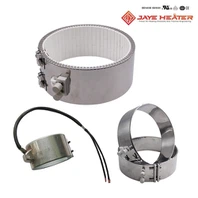
A typical mica band heater contains:
A resistance wire or ribbon that generates heat.
Mica layers that electrically insulate the resistance element.
A metal sheath that protects the assembly.
Clamping hardware that holds the heater against the component.
When power is applied, electrical resistance produces heat. This heat passes through the insulation and inner metal sheath into the barrel or nozzle.

What Role Do They Play in Plastic Processing?
Band heaters supply external heat during machine warm-up and help maintain the required temperature during operation.
| Machine Area | Heating Function |
|---|---|
| Injection molding barrel | Supports barrel warm-up and the required processing temperature profile |
| Extruder barrel | Supplies controlled external heat along selected barrel zones |
| Nozzle | Helps maintain material flow temperature near the outlet |
| Compatible adapters and die sections | Heats cylindrical flow-path components where the installation permits |
How Is Temperature Controlled?
Barrels commonly use several independently controlled heating zones. Each zone combines heaters, a temperature sensor and a controller.
The sensor measures temperature near its installation point, and the controller adjusts heater power to maintain the setpoint. Different zones can use different settings to suit the material and process.
The heater supplies heat; the complete control system determines how accurately temperature is maintained. Sensor placement, controller settings, machine load and cooling arrangements all influence performance. Barrel temperature readings should not automatically be treated as the exact melt temperature.
Why Is Close Surface Contact Important?
Mica band heaters rely heavily on conduction. Gaps between the heater and barrel restrict heat transfer and can cause the heater to run hotter than intended.
Tempco identifies matching the heater's internal diameter to the barrel's outside diameter as an important installation requirement.
For effective installation:
- Specify the actual barrel or nozzle diameter.
- Keep the mounting surface clean and free from plastic residue.
- Select a construction that accommodates installation access.
- Follow the manufacturer's clamping and tightening instructions.
- Avoid forcing a heater open beyond its approved limits.
What Are the Practical Advantages?
For suitable applications, mica band heaters offer:
Compact construction for closely spaced machine components.
Direct surface heating through close contact with the barrel or nozzle.
Custom dimensions and connections for existing equipment.
Serviceable designs that can simplify replacement when access is considered.
Warm-up time, energy consumption and service life depend on heater design, installation and operating conditions. They should be evaluated for the actual machine.
Frequently Asked Questions
Can mica band heaters prevent all cold spots?
No. Correct coverage and installation help, but temperature distribution also depends on barrel geometry, heat losses, sensor position and process conditions.
Why can a band heater overheat while the barrel remains too cool?
Poor surface contact can restrict heat transfer. Incorrect wiring, excessive watt density or a control-system fault may also contribute and should be checked.
Are mica and ceramic band heaters interchangeable?
Not automatically. Their heat-transfer characteristics, temperature capabilities and installation requirements differ. Confirm suitability before changing heater type.
What affects mica band heater service life?
Important factors include operating temperature, watt density, clamping, contamination, electrical connections and temperature cycling.
References
Tempco. Band Heaters. Mica band heater applications and construction options for plastic processing equipment.
Tempco. Refitting a Mica Insulated Band Heater. Guidance on matching heater diameter to the heated component.
JAYE Heater Technology. Band Heater Catalog. Band heater construction and application information.
JAYE Heater Technology. Mica Band Heater. Product range and custom manufacturing information.