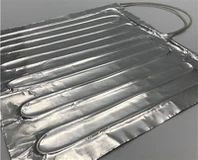
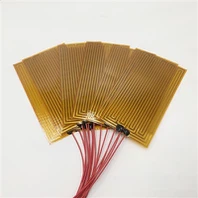
Here is a detailed explanation of what distinguishes the etching process of silicone heaters from traditional heating wire production.

Core Analogy: Printing a Circuit vs. Shaping a Wire
Silicone Heater (Etching Process): This is akin to printing a precise, flat circuit pattern onto a metal sheet. It's a photochemical, subtractive process that creates a 2D plane of heat.
Traditional Heating Wire (Production): This is a metallurgical and mechanical process of drawing, alloying, and forming a 1D line of heat. It's about creating a resilient wire that can be bent or coiled.
The distinctions can be broken down into several key areas:
1. Fundamental Manufacturing Process
| Feature | Silicone Heater (Etching Process) | Traditional Heating Wire Production |
|---|---|---|
| Process Type | Subtractive Manufacturing (Photochemical Etching) | Mechanical Forming & Metallurgy |
| Base Material | A thin, flat foil of metal (e.g., Nickel-Chromium, often 0.02-0.05 mm thick). | A bulk metal alloy (e.g., Nichrome or Iron-Chromium-Aluminum) in rod or thicker wire form. |
| Key Steps | 1. Clean the metal foil. 2. Coat with photoresist. 3. Expose to UV light through a circuit pattern mask. 4. Develop to remove exposed/unexposed resist. 5. Etch away unwanted metal with chemicals. 6. Remove remaining resist. 7. Laminate the etched circuit between silicone rubber layers. |
1. Alloying: Melt and mix metals to achieve desired resistivity. 2. Drawing: Pull the alloy through progressively smaller dies to reduce diameter. 3. Annealing: Heat-treat to relieve stress and adjust properties. 4. Coiling/Forming: Wind the wire into coils or shape it as needed. |
2. Form and Structure of the Heating Element
Silicone Heater (Etched Element): The result is a complex, two-dimensional circuit pattern. This can include parallel paths, zones with different trace widths, and custom shapes. It is inherently a planar (flat) and thin structure.
Traditional Heating Wire: The result is a simple, one-dimensional line. Its form is typically a straight length or a helix (coil) to concentrate heat. It has a much smaller cross-section but greater volume in the third dimension.
3. Performance and Application Implications
This is where the fundamental differences translate into practical advantages and disadvantages.
| Aspect | Silicone Heater (Etching Process) | Traditional Heating Wire |
|---|---|---|
| Heat Distribution | Exceptionally uniform. The wide, flat circuit pattern heats the entire surface area evenly, eliminating hot spots. | Localized and linear. Heat is concentrated along the thin wire or coil. Achieving even heat across a surface is difficult and often results in hot and cold spots. |
| Design Flexibility | Extremely High. The circuit pattern can be any shape photomasked, allowing for custom footprints, multiple heating zones, and integrated sensors in a single element. | Very Low. Limited to linear or simple coiled shapes. Complex layouts require complex mechanical routing and fixtures. |
| Profile & Form Factor | Very thin, lightweight, and flexible. Can conform to uneven surfaces. The final product is a unified, flexible sheet. | Bulky and rigid. Requires external insulation and mounting. Difficult to achieve a low-profile, conformal design. |
| Power Density | Can achieve high and uniform watt density across the entire surface without burning out. | High power density is possible but leads to very high wire temperatures, risking burnout and requiring robust insulation. |
| Ruggedness & Environment | The etched foil itself is fragile, but the final silicone lamination provides waterproof, chemical resistance, and electrical insulation. | The wire itself is mechanically strong but requires external systems (like ceramic beads, MgO powder, or sheaths) for protection from the environment. |
| Cost | Higher cost due to complex, multi-step etching and lamination process. | Lower cost due to mature, high-volume metallurgical and wire-drawing processes. |
Summary Table: Key Distinctions
| Distinguishing Factor | Silicone Heater (Etching) | Traditional Heating Wire |
|---|---|---|
| Primary Process | Photochemical Etching | Wire Drawing & Forming |
| Element Form | 2D Plane / Circuit | 1D Line / Coil |
| Heat Profile | Uniform Surface Heat | Localized Linear Heat |
| Flexibility | Highly Flexible & Conformal | Stiff & Structural |
| Typical Use Case | Precision heating of surfaces (medical devices, aerospace, food equipment). | High-temperature, cost-effective heating in appliances, industrial furnaces. |
In conclusion, the etching process used for silicone heaters is a precision-based, subtractive method that creates a custom-shaped, uniform heating plane. In contrast, traditional heating wire production is a bulk material shaping process that creates a generic, linear heating line. The choice between them hinges on the need for heating uniformity, design complexity, and form factor versus cost and sheer thermal intensity.