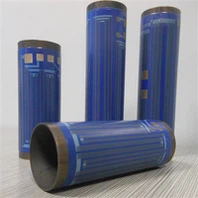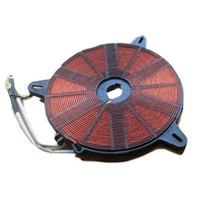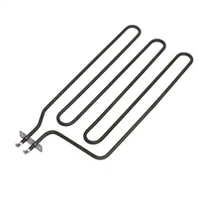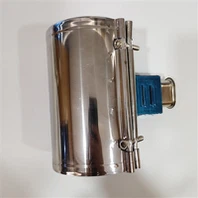
Brands like Bosch, Miele, and Siemens showcase high performance, safety, and longevity. The heating elements of these brands have been built to specific performance standards to provide uniform cooking, energy efficiency, and durability for appliance life. When a manufacturer aims to compete alongside these manufacturers, brands, it is crucial to know and adhere to relevant specifications.
In order to identify the most important specifications, we have organized and labeled them to clarify what is critical.
1. Material and Construction Specifications
The building blocks of a quality heating element are the materials.
1)-Sheath Material: This is the outer tube which encloses the heating coil and the insulator, as a general rule, a bake (bottom) and a broil (top) element from a reputable manufacturer like Bosch will be made from high-grade stainless steel, generally a FeCrAl alloy like Kanthal APM or similar. All of these materials have great resistance to oxidation at continuous elevated temperatures (up to 1400°C / 2550°F), have a long service life, and good resistance to sagging. Grill elements, however, are usually made from Incoloy 840 or other corresponding materials, as this is a stronger and heavier-duty material for cyclic heating applications and/or corrosive atmospheres.
2)-Resistance Wire (Heating Coil): The core conductor is typically a FeCrAl or Nickel-Chromium (NiCr) alloy. FeCrAl is often preferred for its higher operating temperature and longer lifespan. The precise alloy and gauge of the wire determine the resistance and, consequently, the wattage.
3)-Mineral Insulation (MgO): High-purity Magnesium Oxide (MgO) is used as an electrical insulator and thermal conductor between the coil and the sheath. Premium manufacturers insist on high-purity, compacted MgO to ensure efficient heat transfer and prevent electrical leakage or short circuits, even after thousands of thermal cycles.
2. Electrical and Performance Specifications
These specifications describe the essential function of the element.
1)-Rated Voltage & Wattage: This is the most fundamental specification (for example, 240V / 2000W). Wattage is extremely important, as the actual wattage must be very motivated (±5% or so) to the rated value to ensure consistent oven performance and temperature stability.
2)-Watt Density: This is an important engineering consideration, measured in watts per square centimeter (W/cm²): a measure of power output versus sheath surface area. High-quality brands manage watt density carefully to avoid excessive local temperatures that produce hot spots, reduce quality of cooked food, and shorted product lifetime. Appropriate consideration of watt functionality and lower watt density promote uniform heating and longer product lifetime.
3)-Cold Resistance: The cold resistance of the element, measured at room temperature, must also be carefully calibrated to ensure that it correlates with the appropriate wattage at operating voltage. This is a basic and very important QC measurement.
3. Safety and Compliance Specifications
Compliance with international standards is mandatory.
1)-International Certifications: The elements must have the required certifications for their target market. The most common certifications are UL / CSA for North America and VDE / CE / IEC for Europe & International. These certifications show that the element meets strict safety standards for electrical insulation, creepage distances, and temperature ratings.
2)-Dielectric Strength (Hi-Pot Test): The element must pass a high-voltage test (e.g., 1250V or 1500V AC for 1 minute) across the terminals pins and sheath without breakdown. This ensures the safety of the user.
3)-Leakage Current: The electrical current leaking from the live parts to the sheath must be below a very low safe limit (typically <0.5 mA) or acceptable threshold.
4. Physical and Dimensional Specifications
The term precision here represents both compatibility and performance.
1)-Terminal Type & Material: Terminals must be heavy duty, often made of stainless steel or nickel plated brass, designed for a secure fit with spade connectors. The termination seal at the sheath entry must be watertight as well.
2)-Form Factor & Dimensions: The specific form, bend radii, and dimensional specs (Length, Width, Leg Height) must be manufactured precisely for a proper fit within the oven cavity, while allowing airflow and providing the proper clearance from interior panel components.
Surface Finish: A clean, uniform sheath surface finish is imperative in terms of uniform heat radiation and protection from corrosion.
5. Reliability and Life Testing
Apart from meeting initial specifications, top brands require verification of durability.
1)-Cycle Life Test: The element goes through repeated on/off 'cycles' (e.g. on 5 minutes and off 5 minutes) hundreds or thousands of times to simulate multi-year life. Performance cannot fail or degrade.
2)-Salt Spray Test: Assesses overall corrosion resistance by placing the element in a salt fog environment for a predetermined time (e.g. 48, 72 hours) to mimic extreme kitchen conditions.
For a manufacturer like JAYE, simply replicating the quality of a Bosch element involves more than a checklist of voltage and wattage particulars. It is an engineering design thinking approach: comprising material science, an exact electrical design, a host of safety certification, and the validation is unrelenting to ensure safety and functionality. Mastery of these key specifications means the provision of superior quality heating elements to oven manufacturers that meets the end user's expectations of premium level performance of high-quality premium brands.